Many team-building events look alike, and many are forgotten by the following Monday. It doesn’t have to be that way: a successful team-building event depends less on the activity than on how it was prepared. Here’s a method for organising one in Rabat, from the question “why?” to the debrief, with the practical pointers (headcount, duration, venue, budget) you need to decide.
Guide written by the Instant T studio in Rabat, updated in October 2026.
At a glance
To organise team building, work in this order: set the objective (cohesion, onboarding, celebration, relaxation), count the participants, choose a format suited to the team, decide on the venue (your premises or an outside venue), set the duration and budget, then prepare the logistics and gather feedback. A creative activity accessible to everyone, lasting 1.5 to 3 hours, works better than a performance challenge.
- Headcount: 6 to 40 people for a creative workshop; beyond that, split into sub-groups.
- Duration: 1.5 to 3 hours for a workshop; half a day for a longer format.
- Venue: your premises (no travel) or the provider’s venue (a change of scene).
- Lead time: allow four to six weeks between the decision and the date, longer at the end of the year.
Contents
- What’s the objective of your team building?
- What team-building formats are there in Rabat?
- How many participants?
- How long?
- On your premises or elsewhere?
- What budget?
- The steps to organise it
- Close-up: botanical team building
- On the day: a running order that works
- Mistakes to avoid
- How to measure success?
- Frequently asked questions
- Also worth reading
What’s the objective of your team building?
Team building is organised for a specific reason. It determines the format, the timing and how the event is presented to the teams.
| Objective | What you’re looking for | Suitable format |
|---|---|---|
| Team cohesion | For people to talk differently than in meetings | A collaborative activity, done together |
| Onboarding | Welcoming new employees | A short, unintimidating format with no competition |
| Celebration | Saying thank you, celebrating a result or the end of the year | A convivial format, with time to share |
| Relaxation, a break | Catching your breath after an intense period | A calm, hands-on activity |
| Launch, seminar | Opening or closing a key moment | A slot built into a wider programme |
An activity that puts people in competition rarely suits everyone. Quieter people fade into the background, and hierarchies reproduce themselves. Creative formats, where everyone makes their own piece, put everyone on the same level, whatever their role.
What team-building formats are there in Rabat?
| Size | Typical duration | Effect | Things to watch |
|---|---|---|---|
| Hands-on creative workshop (botanical, crafts, cooking) | 1.5 to 3 hours | Focus, natural conversation, something to keep | Materials and space to plan for |
| City treasure hunt | 2 to 4 hours | Mixed teams, dynamic | Depends on the weather and walking |
| Sports or outdoor activity | Half a day | Energy, pushing yourself | Not everyone is at the same level |
| Puzzle games, escape room | 1 to 2 hours | Team problem-solving | Can favour certain profiles |
| Cultural or food tour | 2 to 3 hours | Discovery, conviviality | Less active interaction |
These categories are pointers, not a list of providers. For a mixed team (varied ages, fitness levels and seniority), a creative workshop is one of the most inclusive formats: it requires no performance, no competition and no public speaking.
How many participants?
Headcount decides the format more than any other criterion.
| Headcount | What works |
|---|---|
| Fewer than 6 | A workshop open to the public rather than a dedicated team-building event |
| 6 to 16 | A workshop at the provider’s venue, convivial and closely guided |
| 16 to 40 | A workshop on your premises, or several sessions in sub-groups |
| More than 40 | Several sessions in sub-groups |
At the Instant T studio in Rabat, team building accommodates up to 16 participants; on your premises, we can come for up to 40. We can also book out the studio for a team.
How long?
- 1.5 hours: the minimum for a hands-on workshop. Ideal for an extended lunch break or at the end of the day.
- 2 to 3 hours: the most common length. Enough for a complete creation and time to talk.
- Half a day: if the team building is part of a seminar, with lunch.
The longer the activity, the more you need to plan breaks, drinks and food. During Ramadan, adjust the timing and avoid long or physical activities during the day.
On your premises or elsewhere?
| Criterion | On your premises | At the provider’s venue |
|---|---|---|
| Travel | None | Allow for the journey and time |
| Change of scene | Low | Strong: you get out of the office |
| Capacity | Depends on your room | Depends on the venue (16 people at ours) |
| Logistics | Room, tables, water point to arrange | Everything is on site |
| “Getting away” effect | Smaller | More pronounced |
At Instant T, both options are available. At our Rabat studio (6 Rue Zemmour, Aviation district), team building accommodates up to 16 participants: the materials are on site, the venue can be booked exclusively, and coffee and snacks are optional. On your premises, we can host up to 40 participants: materials, plants and protective covers are provided, with set-up and cleaning included, in Rabat, Salé, Témara and Casablanca. You’ll need a room with tables (meeting room, terrace or open-plan space).
What budget?
Set the budget per participant, checking what the price includes:
- Facilitation (who leads it, and how many people);
- Materials, and what each person takes home;
- Travel for the provider, or venue hire;
- Set-up and cleaning;
- Drinks and snacks, optional or included;
- Invoicing: invoice, agreement, purchase order.
As a guide, our public workshops cost 400 to 500 MAD per person (kokedama, terrarium, bonsai: see the workshops). To try the format before bringing a team, you can sign up for one of these workshops: see the dates. Team building is priced by quote, depending on headcount, venue and duration. Always ask for an all-inclusive quote so you can compare like with like.
The steps to organise it
- Define the objective and the message you want to convey to the teams.
- Estimate the headcount and the date, avoiding year-end closes and peak periods.
- Choose a format suited to the team’s profile.
- Set the budget per person and in total.
- Request two or three comparable quotes, using the same criteria.
- Confirm the venue: your premises or the provider’s.
- Announce the event to participants: date, duration, venue, dress, what they’ll be doing — and what it isn’t (no performance, no competition).
- Gather constraints: dietary requirements, allergies, mobility, toxicity to pets if the creation is going home.
- Prepare the logistics: access, parking, times, welcome.
- After the event, gather feedback and share photos.
Indicative timeline: decision and quote request 4 to 6 weeks before; approval 3 weeks before; announcement to participants 2 weeks before; logistics reminder 2 to 3 days before.
Close-up: botanical team building
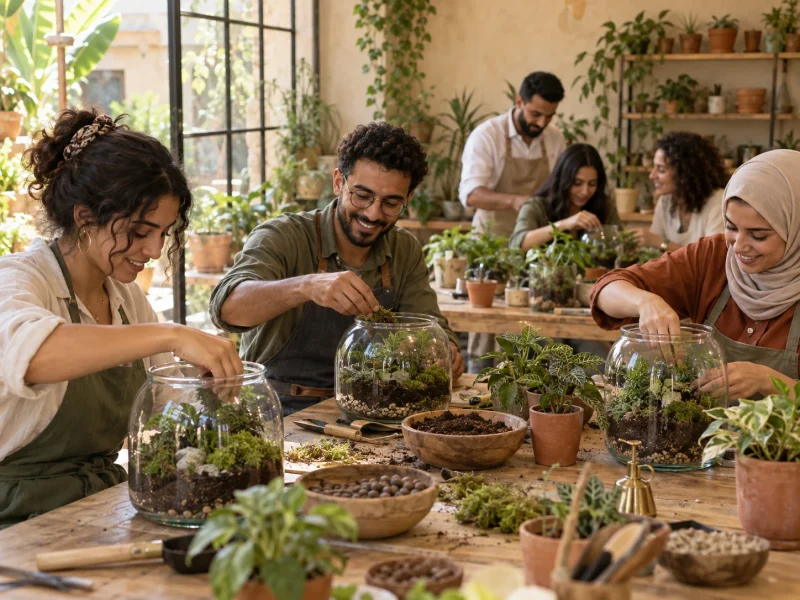
Our own format is the botanical workshop: each participant creates something with their own hands, using simple techniques, and leaves with a living creation to put on their desk. It needs looking after, which extends the effect of the workshop long after the session.
| Workshop | Duration | From | Special feature |
|---|---|---|---|
| Terrarium | 2 hours | 6 people | Everyone composes their own landscape under glass |
| Kokedama | 1.5 hours | 6 people | The Japanese moss ball, very tactile and visual |
| Bonsai | 2.5 hours | 6 people | The art of bonsai, a workshop in patience |
A bespoke format is possible for a seminar, a product launch or the end of the year. To choose between terrarium and kokedama, read terrarium or kokedama: which to choose for team building. If your participants take their creation home, the choice of plant matters: see plants in an air-conditioned office. All the details are on our botanical team-building page.
How it works
- We scope it together: headcount, duration, venue, objective.
- We prepare the materials: plants, potting mixes, containers, protective covers.
- We lead the session: we guide the technique, but everyone composes their own creation. We don’t do it for them.
On the day: a running order that works
For a two- to three-hour workshop, here’s a simple sequence that works for most creative activities:
| Moment | Indicative time | What happens |
|---|---|---|
| Welcome | 15 minutes | Arrival, drinks, settling in; let people relax |
| Opening words | 5 to 10 minutes | A manager restates the intention: to get together, not to perform |
| Instructions | 10 minutes | The facilitator presents the materials and techniques |
| Creation | 1 to 1.5 hours | Everyone works on their piece; the facilitator moves from table to table |
| Break | 10 minutes | Drinks, snacks, free conversation |
| Sharing | 10 to 15 minutes | Everyone shows their creation, without judgement |
| Photo and close | 10 minutes | Group photo, care instructions, thanks |
Also remember to plan for carrying the creations home: a bag or box per participant avoids damage in the car or on public transport.
Mistakes to avoid
- Choosing without an objective. Without one, you can’t judge whether the event succeeded.
- Imposing a physical activity on a team with varied profiles.
- Planning it too long. After three hours, attention drops.
- Overlooking constraints: mobility, dietary requirements, Ramadan, prayer times, allergies.
- Not explaining the event in advance: people engage better when they know what to expect.
- Forgetting to measure: three questions asked the next day are enough to know what worked.
- Booking too late, when year-end periods fill up diaries.
How to measure success?
Three questions, asked the next day or the following week:
- What did you take away from the session?
- Did you talk with colleagues you don’t usually spend time with?
- Would you do this kind of activity again?
A simple indicator: how many participants still have their creation on their desk a month later. That’s what an activity that leaves a trace brings. To extend the effect, office plants can also be looked after: see our maintenance and office planting pages.
Frequently asked questions
What’s the minimum group size for botanical team building?
From 6 people, up to 16 at our Rabat studio and up to 40 on your premises.
How long does team building last?
With us, 1.5 to 2.5 hours depending on the workshop: 1.5 hours for a kokedama, 2 hours for a terrarium, 2.5 hours for a bonsai; a bespoke format is possible. In general, a creative workshop lasts between 1.5 and 3 hours.
How much does team building cost in Rabat?
It depends on the headcount, venue and duration, and is priced by quote. As a guide, our public workshops cost between 400 and 500 MAD per person.
Do participants need any skills?
No. The workshop is designed for beginners: we guide the technique, and everyone composes their own creation.
Can team building be held in our offices?
Yes, on your premises, in Rabat, Salé, Témara and Casablanca. You’ll need a room with tables (meeting room, terrace or open-plan space).
How far ahead should we book?
Allow four to six weeks between the decision and the date, longer at the end of the year as diaries fill up. The quote is free and we reply within 48 hours.
Can we get an invoice or an agreement?
Yes, on request.
Can team building be combined with corporate gifts?
Yes. Giving the team an experience and a botanical gift is a common combination: see our advice on end-of-year corporate gifts.
Also worth reading
- Terrarium or kokedama: which to choose for team building?
- End-of-year corporate gifts in Morocco
- Plants in an air-conditioned office
- Which plant to give a colleague or client?
Planning team building for your team? Request a free quote on our botanical team-building page or via the business quote form: we reply within 48 hours. You can also message us on WhatsApp at 06 61 05 26 38. The studio is at 6 Rue Zemmour, Aviation district, Rabat.