An air-conditioned office is a hostile environment for a plant, and rarely for the reasons people imagine. Temperature isn’t the problem: twenty-two degrees suits most tropical plants.
The problem is what air conditioning does to the air around them.
Three simultaneous stresses
Dry air
An air conditioner cools by condensing the moisture in the air and removing it. So it mechanically dries out the atmosphere. An air-conditioned office often drops below 35% relative humidity, whereas most houseplants want 50 to 60%.
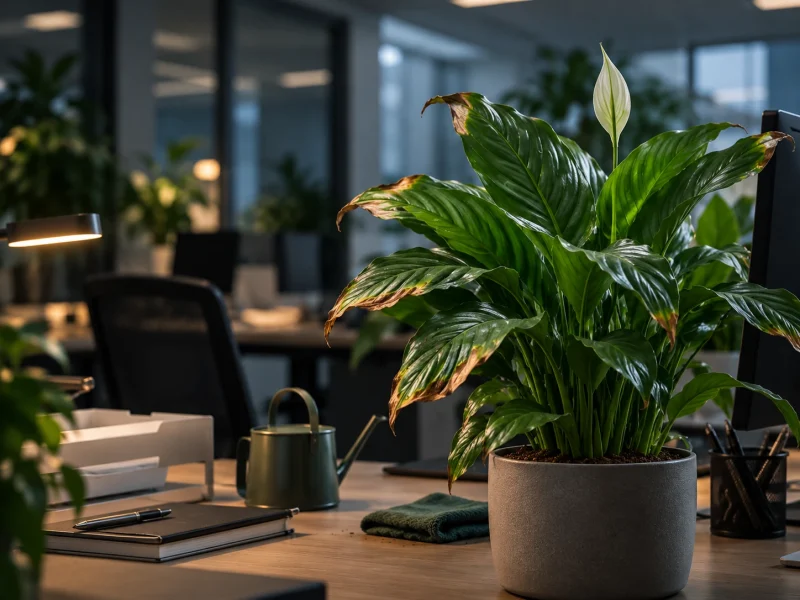
The symptom is easy to recognise: leaf tips turn brown and dry out even though the potting mix is properly moist. Many people read this as a lack of water and water more — which adds a second problem to the first.
The constant draught
A plant placed in the direct airflow of a vent is subjected to a constant draught. The leaves lose water through evaporation faster than the roots can supply it.
A plant two metres from a vent and the same plant in the direct airflow look nothing alike after three months.
The weekend swings
This is the most underestimated factor. The air conditioning switches off on Friday evening and back on on Monday morning. In between, the temperature rises, the humidity too, then everything drops abruptly.
This cycle, repeated every week, wears plants out more surely than air conditioning that runs all the time.
The plants that hold up
- Sansevieria — thick foliage, little evaporating surface, indifferent to dry air. The most reliable of all under air conditioning
- Zamioculcas — the same logic, with the bonus of tolerating low light
- Aspidistra — slow, tough, unbothered by fluctuations
- Pothos — copes well, as long as it isn’t in the airflow
- Aglaonema — good tolerance; choose green varieties in low light
- Ficus elastica — its thick, waxy leaves resist drying out better than most
What they have in common is simple: they all have thick or leathery foliage. The thinner the leaf, the more it suffers.
The plants that almost always fail
- Ferns — they need high humidity and turn brown within weeks
- Calathea and Maranta — the same demands, and they also react badly to hard water
- Ficus lyrata — it drops its leaves at the slightest draught
- Orchids — they sometimes survive, but never flower again in these conditions
Where to place them
The most useful rule fits in one sentence: never in line with an air vent. Look up, spot the grilles, and place the plants outside their cone of airflow.
Two other habits help a lot. Group plants together rather than scattering them — together, they maintain a slightly more humid microclimate around them. And keep them away from exposed picture windows, where the gap between direct sun and cold blown air creates constant stress.
Watering, counter-intuitively
Dry air gives the impression that you need to water more. It’s wrong, and it’s how plants get drowned in air-conditioned offices.
The surface of the potting mix dries quickly, which is misleading. But deeper down, in a cool room where the plant is growing little, the water stays. Push a finger in up to the second knuckle before each watering — it’s the only reliable method.
If the dry air worries you, act on the air, not on the soil: group plants together, stand pots on a bed of damp clay pebbles, or place a dish of water nearby.
The question of responsibility
In the offices we maintain, the number one cause of failure isn’t botanical. It’s that nobody has been put in charge.
A plant without a carer dies in one of two ways: nobody waters it, or everybody does. The second is more common and quicker.
One plant with a responsible person is worth more than ten plants with nobody.
If you’re bringing plants into an office, appoint someone — or outsource the maintenance. A monthly visit is usually enough to keep a collection in good shape.
Instant T plants and maintains workspaces in Rabat and Casablanca: light and airflow assessment, tailored selection, installation and regular visits. See our office planting page.