We know how to give a plant to someone close: we know their home, their light, their relationship with plants. In a business, none of that applies. You’re giving to dozens of people whose homes, habits and interest you know nothing about.
That completely changes the selection criteria.
Criterion number one: tolerance of neglect
In a group of fifty people, a good number won’t look after the plant. That’s neither a judgement nor a problem — it’s a fact to take into account.
So the plant you give must survive inattention. Not “cope with” it — survive it. Three weeks without water, mediocre light, a radiator too close.
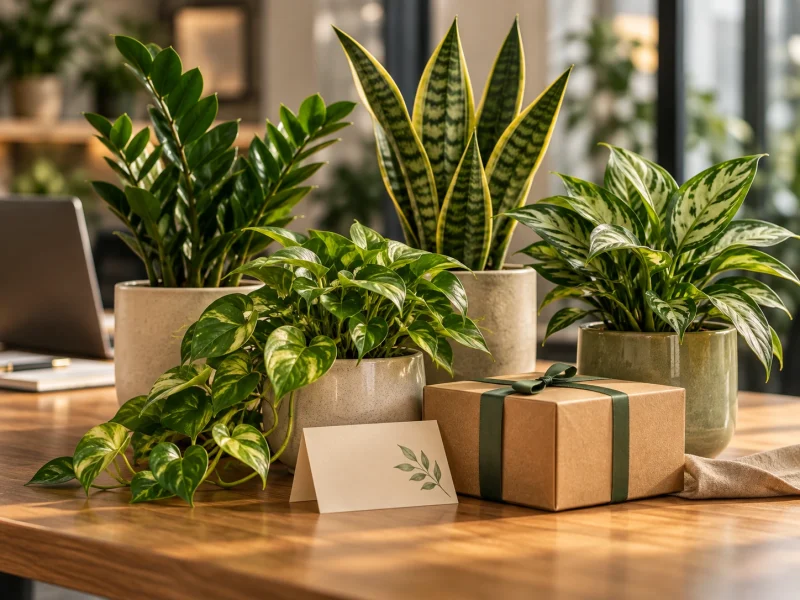
Three species pass this test without question: Zamioculcas, Sansevieria and Pothos. They aren’t rare, and that’s exactly why they work.
A successful gift isn’t the one that impresses when it’s unwrapped. It’s the one that’s still there a year later.
Size matters as much as species
A plant given at work must fit on the corner of a cluttered desk and be able to go home in a bag. If it doesn’t fit in a bag, it will stay at the office — and at the office, nobody looks after it during the holidays.
Aim for a container twelve to fifteen centimetres in diameter, with a total height under forty centimetres. Any bigger and you’re giving a burden.
What to avoid when giving in quantity
- Flowering plants — the flowers last three weeks, after which the gift looks like a failure
- Orchids — given in huge numbers, experienced as a test, thrown away after flowering
- Rare or delicate species — rarity flatters the giver, not the recipient who is going to lose it
- Toxic plants — Dieffenbachia, Philodendron and Alocasia are a problem for anyone with a cat or a young child, and you have no way of knowing
- Very large plants — they impress in photos and are a nuisance in real life
What makes the difference, for next to nothing
The care sheet
It’s the most neglected element and the most decisive. A few lines: how much water, how often, what light, what to do if the leaves turn yellow.
Without it, people guess — and often guess wrong. With it, the plant stands a real chance. That’s what turns a gift into something people keep.
The container
A beautiful plant in a black nursery pot is only half a gift. A simple planter — terracotta, matt ceramic, concrete — completely changes how it’s perceived, for a few extra dirhams per piece.
A discreet logo
An engraved wooden tag hung on the container works better than a logo printed on the pot. It gets noticed without imposing itself, and it survives repotting.
A large screen-printed logo turns the gift into promotional merchandise — and promotional merchandise ends up in a drawer.
Practical questions to settle early
- Lead time — plants aren’t made to order. Allow three weeks between approval and delivery, longer for more than a hundred pieces
- Handover — plants don’t travel well in bulk. Plan an on-site handover rather than individual shipments
- Timing — avoid giving them just before a long closure. A plant alone in an empty office for two weeks doesn’t stand a chance
- A sample — ask for one before ordering the full run. What looks good in a photo doesn’t always look good in your hands
And if you want to go beyond the potted plant
Two formats work well in business and stand out from the ordinary.
The closed terrarium is almost self-sufficient: it recycles its water and lasts for months without attention. It’s the best choice for a recipient you know won’t look after anything.
The gift box — a plant, a potting mix, a fertiliser and a care sheet — has a perceived value well above its cost, because it provides the means to succeed as well as the object itself.
Instant T prepares botanical corporate gifts in Rabat, from ten pieces, with an engraved tag and care sheet. See the collections and request a quote.