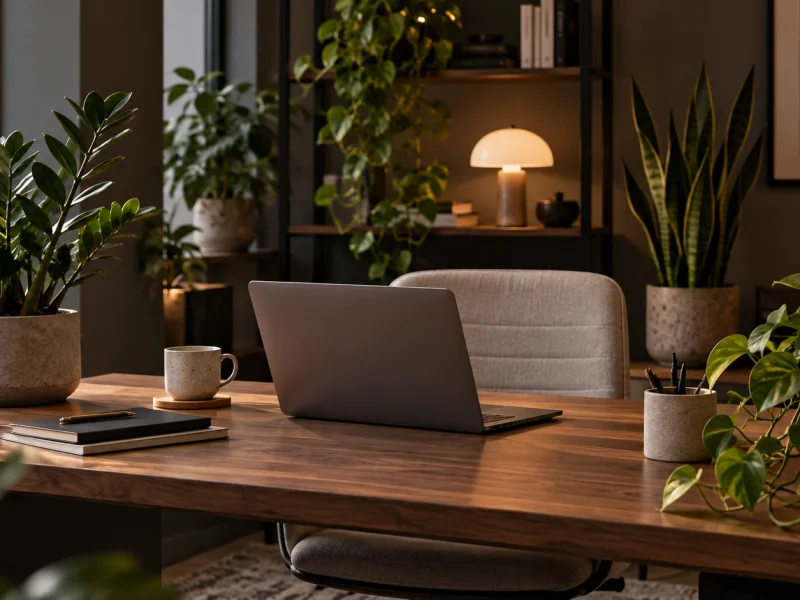
It’s the most common request for business projects: an office with only borrowed light, an open-plan space lit by fluorescent tubes, a windowless corridor. People want greenery, and have already killed two or three plants in that spot.
Let’s start by clearing up a misunderstanding, because it explains most failures.
There’s no such thing as a plant that “lives in the dark”
All plants need light to live. Photosynthesis is their only source of energy: without light, a plant uses up its reserves and then fades away.
What does exist are understorey plants. In their native habitat, they live beneath a dense canopy that filters the light. They have developed leaves capable of using very few photons. These are the ones that hold up in a dark office.
But even they have their limit. A completely windowless room doesn’t suit any plant in the long term — unless you install grow lights, which is another conversation.
Office lighting barely counts
A fluorescent tube or LED office spotlight produces light designed for the human eye, not for photosynthesis. The intensity useful to plants is very low.
A plant placed five metres from a window, under fluorescent lights on for ten hours a day, essentially receives light from the window. The office lights make almost no difference.
Eight plants that really hold up
Zamioculcas — the toughest of them all
Fleshy rhizomes that store water, glossy foliage and an almost unreasonable tolerance of neglect. It copes with several weeks without water and very low light. If you were to choose just one, this is it.
Sansevieria — the snake plant
Upright, graphic and practically indestructible. It accepts dimness and makes do with one watering a month in winter. Its slender shape works well in an entrance or between workstations.
Pothos — the fastest
It grows quickly, trails beautifully from a shelf and forgives almost anything. It’s also the one that warns you: its leaves visibly droop when it’s thirsty and perk up within a few hours of watering.
Aspidistra — the plant of the last century
It was known as the cast-iron plant. It survived candlelit Victorian drawing rooms. Slow and discreet, it tolerates conditions nothing else will.
Aglaonema — for those who want colour
Foliage variegated with cream, silver or pink depending on the variety. Be careful, though: the paler the foliage, the more light it needs. In a dark office, choose the green varieties.
Philodendron scandens — the obliging climber
Heart-shaped leaves, supple growth, copes with low light. You can let it trail or train it up a pole.
Spathiphyllum — the peace lily
One of the few plants that flowers in moderate light. It has the same reflex as Pothos: it droops when it’s thirsty. It needs a little more water than the others on this list.
Chamaedorea — the parlour palm
To bring volume and height without needing direct light. It gives structure to a space where a low plant would barely be noticed.
The ones to avoid in a dark office
- Ficus lyrata — stunning, much sought after, and the first to drop its leaves when light is insufficient
- Cacti and succulents — these are full-sun plants. They stretch, grow leggy and turn pale in a dark interior
- Calathea and Maranta — superb, but demanding when it comes to humidity and sensitive to hard water
- Variegated plants in general — the white areas don’t photosynthesise, so they need more light, not less
The truth about air-purifying plants
The NASA study quoted everywhere dates from 1989. It was carried out in sealed chambers of less than one cubic metre, with pollutant concentrations unrelated to a real office.
Scaled up to a ventilated room, you would need a frankly unrealistic density of plants — several dozen per room — to obtain a measurable effect on air quality.
That doesn’t mean plants are useless in the office. The documented effects lie elsewhere, and they are real: lower perceived stress, better concentration, a sense of belonging to the place. It simply isn’t a matter of chemical filtration.
We don’t put plants in offices to purify the air. We put them there because a living space is a better place to work than a dead one.
Three classic mistakes in the workplace
The pot without drainage. A decorative planter with no hole or saucer holds water at the bottom. The roots sit in water and the plant dies within a few months without anyone understanding why.
The Friday group watering. Every plant watered on the same day, with the same amount. Yet a Zamioculcas and a Spathiphyllum have neither the same needs nor the same rhythm.
Nobody is responsible. This is the number one cause of failure. A plant without a designated carer is a plant that dies — either from neglect or from repeated watering by several well-meaning people.
Instant T brings plants into workspaces in Rabat and Casablanca — light assessment, tailored plant selection, installation and monthly maintenance. See our office planting page.