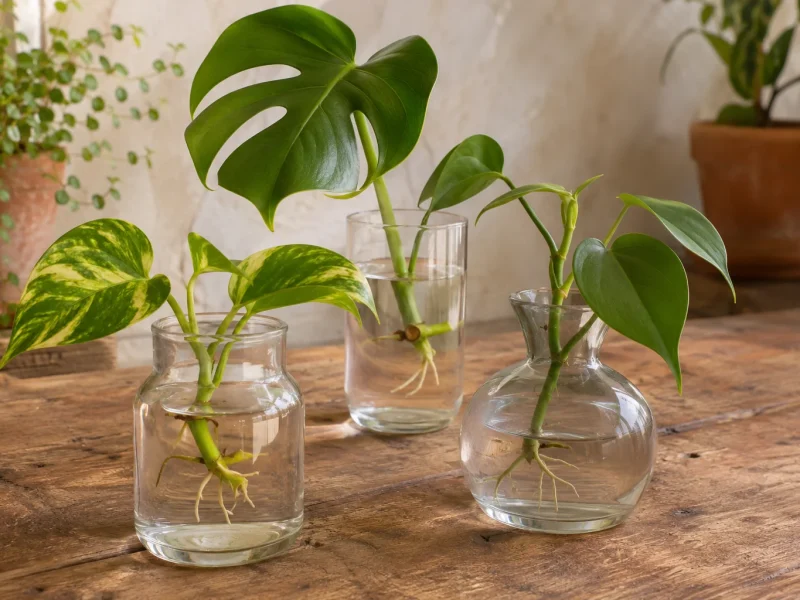
A stem, a glass of water and a little light: watching roots appear within a few weeks is one of the simplest pleasures of indoor gardening. It is also the best way to multiply your plants, share them, or save a broken stem. Here is how, step by step.
The plants that root best in water
- Pothos (Epipremnum), golden, variegated or N’Joy: the easiest, with roots in two to three weeks.
- Climbing philodendron and Scindapsus.
- Monstera: a little slower, but spectacular.
- Syngonium, tradescantia, coleus, and many herbs such as basil or mint.
Succulents and cacti, on the other hand, are propagated dry: in water, they rot.
Where to cut
The secret comes down to one word: the node. It is the small bump on the stem at the base of a leaf, often with a brown aerial root. This is where the roots will grow. Cut just below a node, with a clean, sharp tool, for a cutting 10 to 15 cm long with two or three leaves. Remove the lowest leaf: no leaf should sit in the water.
Step by step
- Fill a glass with room-temperature water, ideally low in limescale or left to stand overnight.
- Place the stem so the node is under water and the leaves above.
- Put the glass in bright but indirect light, never direct sun: the water would heat up and turn green.
- Top up the water when the level drops, and change it completely every seven to ten days.
- Be patient: the first roots appear in two to six weeks depending on the plant and the season.
A mineral base, for support and air
A few centimetres of perlite or clay pebbles at the bottom of the glass keep the stem upright and let air circulate around the roots. It also looks better. Our glass wall planter is designed for exactly this: a sphere or tube to hang on the wall, with its bracket, a cutting chosen with you and this mineral base.
Keep the cutting in water, or pot it up?
Both are possible. Pothos and philodendron can live in water for a long time, as long as it is changed regularly and a few drops of gentle fertiliser are added now and then. For a plant that really grows, pot it up when the roots are 5 to 8 cm long: in a small pot with drainage holes and a light mix, keeping the soil slightly moist for the first two weeks while the water roots adapt to soil.
The most common mistakes
- A cutting without a node: a single leaf with its stalk sometimes roots, but never grows a new stem.
- Leaves sitting in water: they rot and cloud the water.
- Direct sun: the water heats up and algae grow.
- Water never changed: it loses oxygen and the stem turns black.
Frequently asked questions
Why won’t my cutting root?
Most often there is no node under water, or it is too cool: in winter everything is slower. Be patient, and choose a bright, warm spot.
My stem is turning soft and brown, what should I do?
Cut above the damaged part, below a healthy node, rinse the glass and add fresh water.
Can you propagate all year round?
Yes, but spring and summer give the fastest results.
Sharing cuttings
A cutting is also a gift and a way to meet people. At the Gardening & Plants Morning, at the Rabat studio, plant lovers swap cuttings and tips. And for any question about a plant, the Plant Doctor answers free of charge.