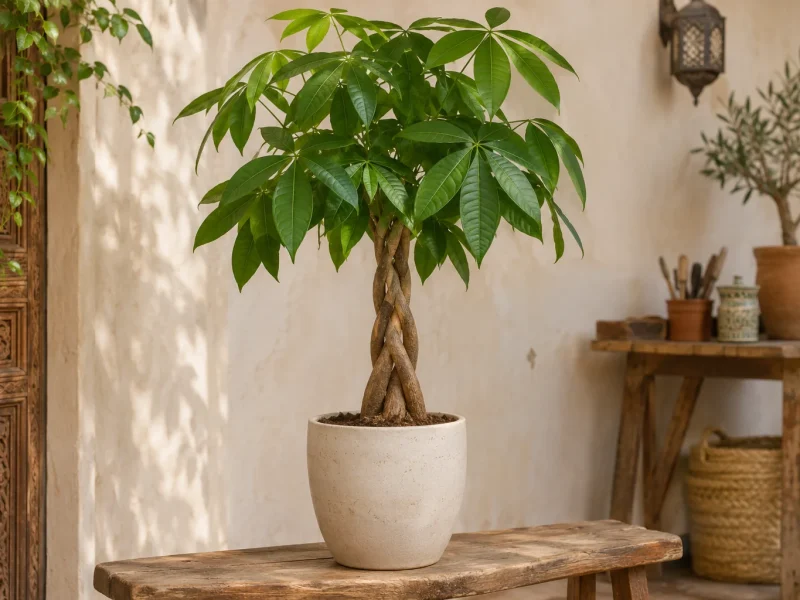
With its braided trunk and crown of large, glossy palmate leaves, Pachira aquatica looks every bit like a small exotic tree. It is also called the money tree, or Guiana chestnut. It comes from the wetlands of Central and South America, where it grows along riverbanks. Indoors, it is one of the easiest plants to live with, on one condition only: do not overwater it.
Why is its trunk braided?
The braided trunk is not natural: in nurseries, several young pachiras are planted side by side and their still-supple stems are braided together. As they grow, they thicken and fuse into a single sculpted trunk that gives the plant its character. The trunk is also a reservoir: it stores water, which is why the pachira copes better with being forgotten than with too much water.
Where to place it
- Light: bright but indirect, near a bright window. A little morning sun suits it; harsh afternoon sun through glass can mark the leaves.
- Temperature: between 16 and 28 °C, never below 12 °C. Away from draughts and air conditioning blowing on it.
- A stable spot: it dislikes being moved. After a move, it sometimes drops a few leaves while it adjusts.
Water it, without excess
This is the key point. Water when the soil is dry two to three centimetres down, generously, then let it drain and empty the saucer a quarter of an hour later. In summer, that is about once a week; in winter, every two to three weeks. A trunk that softens at the base is a sign of overwatering: act quickly.
It appreciates slightly humid air: mist the leaves in the morning, especially in summer and when the air conditioning is on, with a fine-mist spray bottle.
The right potting mix
The pachira needs rich but very free-draining soil that never stays soggy. A quality potting mix, such as our Signature Potting Mix, lightened with a third of perlite or pozzolana, and a pot with drainage holes and a drainage layer at the bottom.
Feeding, pruning and repotting
- Feeding: once a month all year round, a gentle fertiliser such as our compost tea root feed.
- Pruning: in spring, cut back stems that grow too long, just above a leaf: the pachira branches out and keeps a compact crown, bonsai-style.
- Repotting: every two to three years, in spring, into a pot only slightly larger. It likes to be a little snug.
Common problems
- Yellow leaves falling: almost always too much water, or not enough light. Water less often and move it closer to a window.
- Brown, dry leaf edges: air too dry, sun too strong, or very hard water.
- Leaves dropping suddenly: a move, a cold draught or a cold snap. Let it adjust, without watering more.
- Soft trunk at the base: rot caused by overwatering. Take the plant out of its pot to check the roots, or show it to us.
- Fine webs and dull leaves: spider mites, encouraged by dry air. Shower the foliage and treat with black soap.
The money tree as a gift
In Asian tradition, the pachira is associated with prosperity: it is a popular gift for a new home, a shop opening or a new office. It is considered safe for cats and dogs, which makes it an easy gift. Trained bonsai style, it forms a small landscape, like our braided Pachira and fittonia composition. To discover other trees and the art of shaping them, see also The art of bonsai.
Frequently asked questions
Is the pachira easy to care for?
Yes, it is one of the most forgiving houseplants. Its only real weakness is overwatering.
Can it live in an office?
Yes, if it gets light from a window. It copes well with office air, as long as it is kept away from the air conditioning.
Should the braid be undone as it grows?
No. The stems fuse naturally; just remove any original ties if they are tightening around the trunk.
Can it go outside?
In Morocco, it can spend the summer on a terrace in partial shade, away from midday sun, and should come back in as soon as nights drop below 12 °C.
Need advice?
Is your pachira dropping leaves, or is its trunk worrying you? Send a photo of the plant, a leaf and the base of the trunk to the Plant Doctor: the diagnosis is free. You can also visit the studio, 6 Rue Zemmour, Aviation district, Rabat, Tuesday to Saturday from 10am to 6pm, or leave it with us for repotting at the studio.