When you’re new to houseplants, it’s easy to think that potting soil is just potting soil. After all, they often look alike: dark, rich, ready to welcome a plant. Yet, as with cooking or gardening, not every mix meets the same needs.
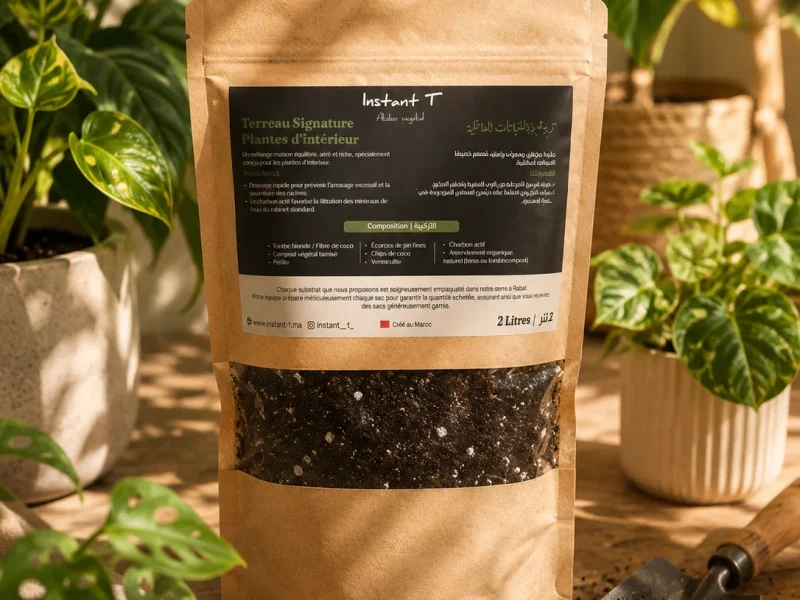
At Instant T, we offer a Signature Potting Mix designed specifically for tropical houseplants. But how does it really differ from a standard all-purpose compost?
All-purpose compost: a versatile solution
All-purpose compost lives up to its name. It’s designed to suit a wide range of plants and uses: window boxes, seasonal flowers, outdoor plants, small shrubs and general planting. Its main advantage is versatility. It lets you repot a wide variety of plants easily without overthinking it.
However, that versatility also involves some compromises. To cover as many situations as possible, all-purpose composts are often denser and hold more moisture. That may suit some plants but is less suitable for many tropical species grown indoors.
Houseplants have particular needs
Most of the plants we bring into our homes come from tropical forests. Monsteras, Philodendrons, Syngoniums, Pothos, Anthuriums and Alocasias grow naturally in soils that are rich in organic matter but also very airy.
In their natural environment, their roots never sit in heavy, compacted soil. They grow through a mix of decomposing leaves, bark, organic matter and pockets of air.
When water sits around the roots for too long, problems appear:
- yellowing leaves;
- slower growth;
- root rot;
- fungal growth or pests.
That’s often why some plants seem to decline despite regular watering and good light.
Why did we create our Signature Potting Mix?
We developed our Signature Potting Mix to get closer to the conditions tropical plants naturally encounter.
It combines:
- coco coir;
- sieved plant compost;
- perlite;
- vermiculite;
- fine pine bark;
- activated charcoal.
Each component plays a specific role. Coco coir helps retain moisture in a balanced way. Perlite and vermiculite improve aeration and stop the mix from compacting. Pine bark creates spaces where roots can breathe. Activated charcoal helps maintain a healthier environment around the root system.
The aim isn’t to hold more water, but to strike the right balance between moisture, oxygen and drainage.
The everyday benefits
In practice, a more airy potting mix offers several advantages:
- more forgiving watering;
- stronger root development;
- less risk from overwatering;
- steadier growth;
- less frequent repotting.
Of course, no potting mix will ever replace good light or the right watering. But it is the foundation on which a plant’s health rests.
Should you give up all-purpose compost?
Not necessarily. All-purpose compost remains a perfectly valid choice for many plantings.
However, if you mainly grow tropical houseplants, a mix designed specifically for their needs can make a real difference in the long run.
It’s a bit like choosing the right shoes for a particular activity: you can walk in any pair, but some are simply better designed for a specific use.
What happens beneath the surface
When we admire a plant, we look at its leaves, its colours or its shape. Yet the most important part remains hidden. A plant’s health often begins beneath the surface, where the roots find the water, air and nutrients they need to grow.
Choosing a good potting mix may not be the most spectacular thing you do for a plant. But it is often one of the most decisive. At Instant T, we believe a healthy plant starts with an environment that respects its nature. And that begins, quite simply, with the soil it grows in.