A plant isn’t a gift like any other. A book sits on a shelf, an object gets put away. A plant asks for things. It gets thirsty, leans towards the light, drops a leaf. It hands a small responsibility to whoever receives it.
That’s what makes it a meaningful gift — and why it’s possible to get it wrong. Here’s how not to.
The first question isn’t “which plant”
It’s: who is receiving it, and where will it live?
A magnificent plant given to someone with neither the time nor the inclination to look after it doesn’t make a good gift. It becomes an object that slowly withers before its owner’s eyes, with a little guilt to go with it.
Three things to know before choosing: how bright the home is, how much time the person can give it, and whether they already have plants — and so some idea of what they’re doing.
Depending on the person
Someone who has never had a plant
Go for absolute toughness. Zamioculcas, Sansevieria or Pothos. These three forgive neglect, excess and dim light. The person will succeed, gain confidence and want more.
This matters: the first success often decides whether someone becomes a plant lover or concludes they “don’t have green fingers”.
Someone who travels or is often away
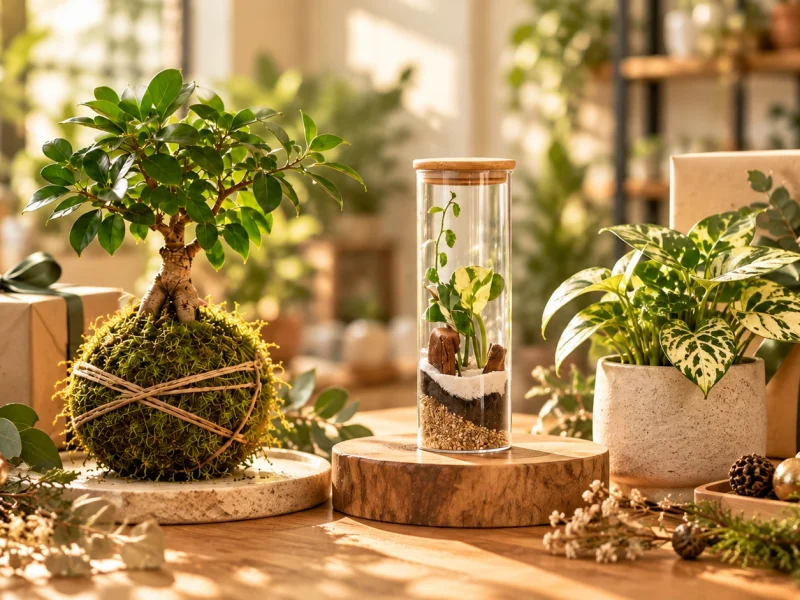
Succulents, cacti, Zamioculcas. Anything that stores water. Or a closed terrarium, which recycles its own moisture and can go for weeks without attention.
Someone who already has lots of plants
Don’t give them yet another Pothos. Look for a less common variety, or an object rather than a plant — a beautiful ceramic planter, a quality tool, a specialist potting mix.
Or change register: a kokedama isn’t a potted plant, it’s a different way of bringing a plant to life. Even a collector may not have one.
Someone who is moving house
A medium-sized plant that fills the space without cluttering it. A Chamaedorea, a Philodendron, a Ficus elastica. The gesture says something precise: this place is becoming a living place.
An office
See our recommendations for dimly lit spaces. Small, tough, with no particular need for humidity. And a simple container — an office isn’t a living room.
What to avoid
- Orchids — given in huge numbers and experienced as a test. Most people throw them away after flowering without knowing they can flower again
- Supermarket flowering plants — forced in greenhouses, they often collapse a few weeks after purchase
- Very large plants — you impose something bulky the person may not have planned for
- Toxic plants for someone with a cat or a young child — Dieffenbachia, Philodendron, Alocasia and Spathiphyllum are a problem if eaten
- A sick or struggling plant — it sounds obvious, but check the undersides of the leaves before buying
Presentation matters more than you think
A beautiful plant in a black plastic nursery pot is only half a gift. The container is half the object.
Choose a planter that suits the person’s interior, not the plant. Terracotta for a warm interior, pale ceramic for a minimalist space, concrete for a contemporary one.
And above all, include a note on care with the gift. A few lines are enough — how much water, how often, what light. That’s what turns a plant given as a gift into a plant that survives.
Giving a plant without saying how to look after it is like giving a musical instrument without saying how to play it.
Corporate gifts
In a business, the logic changes. You need an object that works for dozens of people whose homes and habits you don’t know.
So, three rules. Choose toughness over rarity, since the recipient is unknown. Always include the care sheet. And favour a compact size that fits on a desk and is easy to carry.
That’s exactly what we prepare for businesses: terrariums, kokedamas and botanical gift boxes designed to be given in quantity, with an engraved label and a care sheet.
Looking for a botanical gift for your teams or clients? See our corporate gift collections. For a personal gift, drop by the studio — 6 Rue Zemmour, Rabat.