It’s the question that comes up with every quote. Both workshops last half a day at most, cost about the same, and everyone leaves with a creation. So which should you choose?
The answer depends less on budget than on what you expect from the session — and on very practical constraints that are often overlooked.
What really sets them apart
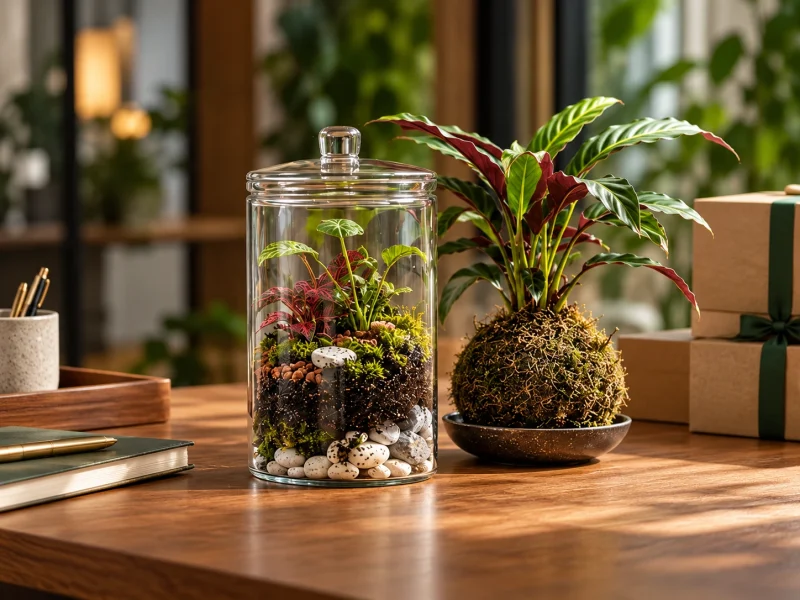
The terrarium: composing a landscape
You build a closed world under glass. Drainage, charcoal, potting mix, plants, moss, mineral elements: each layer has a purpose, and you need to understand it before adding the next.
It’s a workshop about decisions. Where to put the stone, which plant goes in front, whether to add height. Participants compare their compositions, advise one another, change their minds. There’s a lot of conversation.
Allow two hours, fairly clean hands, and a finished object that sits on a desk.
The kokedama: getting your hands dirty
You wrap a plant’s roots in a clay-rich soil mix, shape a ball, dress it in moss and bind it with string.
It’s a workshop about touch. You knead, squeeze, feel the material. There’s much less to decide and much more to do with your body. People laugh more and talk less.
Allow an hour and a half, dirty hands — really dirty — and an object that’s more delicate to carry home.
Depending on the purpose of the day
- An intensive seminar, teams who’ve been thinking hard since morning — the kokedama. It brings people back into their bodies and lets off steam. The terrarium would add another layer of thinking where less is needed.
- A team whose members barely know each other — the terrarium. The decisions to be made naturally spark conversation, and comparing compositions gives a topic to those who struggle to find one.
- End of year, a festive moment — the kokedama. Quicker and lighter, it leaves time for everything else.
- A group where some people dread this kind of activity — the terrarium. You can stay in the background and still succeed. The kokedama puts people more on show.
The constraints people discover too late
Transport
This is the most underestimated point. A terrarium is made of glass: it travels well lying flat in a car boot, badly in a backpack or on a tram. A kokedama is unbreakable but damp, and it stains.
If your participants are going home by public transport or catching a flight the same evening, the question is worth asking beforehand, not afterwards.
Space and tables
The terrarium needs surface area: each person spreads out their materials, plants and stones. Allow a comfortable seat for every participant.
The kokedama needs less surface but much more protection. You’re working with wet soil — you’ll need dust sheets, buckets and a water point nearby. In a carpeted open-plan office, it needs thinking through.
Number of participants
With more than twenty or so people, the kokedama copes better: the technique is easier to guide as a group. The terrarium doesn’t work well with very large groups if everyone is to get real advice.
And what about care afterwards?
A point rarely raised, yet decisive if you want the memory to last.
A closed terrarium is almost self-sufficient: it recycles its water and can last months without attention. It’s the perfect gift for someone who has never had a plant.
A kokedama needs regular watering by soaking, and it dries out quickly. It’s more beautiful but more demanding. Given to an entire team, there will be casualties within six months.
If the aim is for something to still be on people’s desks in a year, the terrarium wins.
A third way
There’s no obligation to choose for everyone. For groups of around fifteen, we sometimes run both workshops side by side, with each person signing up for the one that appeals to them.
The effect is interesting: two atmospheres coexist in the same room, and people move around to see what the others are doing. It takes a little more logistics, but the result is often livelier than a single workshop.
Instant T runs team-building workshops in Rabat, Salé, Témara and Casablanca — at our studio or on your premises. See the offer and request a quote.