The label on a Monstera says “bright but indirect light”. On a Pothos: “soft light”. On a Calathea: “partial shade”. Then you look around your living room and have no idea where to put what.
The problem is real: these terms have no official definition. Every brand and every website uses them in its own way. This article sets out a simple scale, a test you can do at home and some pointers for reading your windows.
Why light comes before everything else
A plant makes its energy from light. It’s its only source of food. Fertiliser doesn’t replace light, and perfect watering won’t save a plant kept in the dark. So when a plant declines, the first thing to check is its position — before water and before fertiliser.
It also explains the watering rhythm: the more light a plant receives, the more water it uses. The two are adjusted together — see our article on when to water.
The five-level scale
1. Direct sun
The sun’s rays touch the leaves directly for several hours. Shadows are crisp, with sharp edges. This is what cacti, succulents and aloe vera need. Most tropical houseplants cope with it poorly: behind glass, direct afternoon sun can scorch their foliage.
2. Bright indirect light
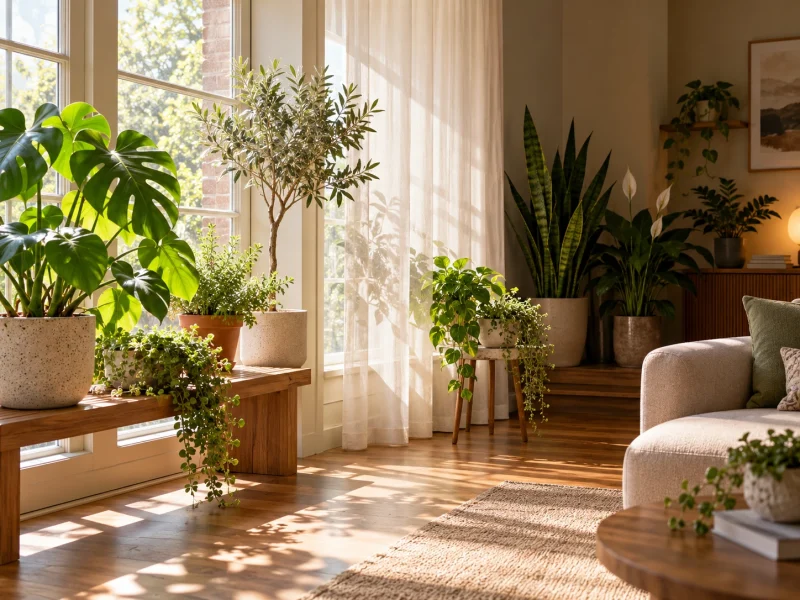
The space is very bright, but the rays don’t reach the leaves — either because a sheer curtain filters them, or because the plant is one or two metres from a large sunny window. This is what labels call “bright but indirect light”, the best situation for many popular plants: Monstera, Ficus elastica, Ficus lyrata, Strelitzia.
3. Medium light, or “soft light”
A well-lit room, but with the plants some distance from a window, or near a north-facing window. The word “soft” almost always refers to this level: moderate, constant light without glare. Pothos, Philodendron scandens, Spathiphyllum, Chamaedorea, Calathea, Aglaonema and Chlorophytum thrive here.
4. Low light
A corner far from any window, a corridor with narrow openings, an office with borrowed light. Few plants hold up here: Sansevieria, Zamioculcas and Aspidistra can. Bear in mind that “tolerates” doesn’t mean “likes”: they survive there and grow slowly.
5. Darkness
A windowless room. No plant thrives there without grow lights: over time, it uses up its reserves and fades away.
The hand-shadow test
It needs no equipment. On a bright day, around noon, hold your hand thirty centimetres above the plant’s spot, with a sheet of white paper underneath.
- A crisp shadow with sharp edges: strong light, or even direct sun.
- A visible shadow with soft edges: bright indirect or medium light.
- A blurred, barely visible shadow: low light.
- No shadow at all: darkness.
Repeat the test in winter: the same window gives a completely different result.
Reading your windows
In the northern hemisphere, orientation makes a big difference:
- South: the brightest, all day long. In summer, the high sun doesn’t reach as far into the room; in winter, it reaches deep inside.
- West: strong, hot sun late in the day. It’s the riskiest aspect for leaves behind glass.
- East: gentle morning sun, then bright indirect light. One of the best for houseplants.
- North: no direct rays, constant moderate-to-low light.
Add what orientation doesn’t tell you: neighbouring buildings, a tree, a balcony casting shade, a pale wall reflecting light, a heavy curtain. And above all distance: intensity drops very quickly as you move away from a window. One more metre can mean one level lower on the scale.
Lux, as a reference
Lux measure illuminance. A few orders of magnitude: full summer sun exceeds 100,000 lux, while a room lit by electric light provides around 300 to 500. That’s why the fluorescent lights in an office do almost nothing for a plant — as we said in our article on plants for dimly lit offices. The light that counts comes from the window.
Phone apps can measure lux, but their results are approximate. The hand-shadow test is more telling.
Which plant for which light
| Light level | Typical spot | Plants that thrive there |
|---|---|---|
| Direct sun | South or west window, unfiltered | Cacti, succulents, aloe vera |
| Bright indirect | Near a bright window, sheer curtain, or 1 to 2 m from a sunny window | Monstera, Ficus elastica, Ficus lyrata, Strelitzia |
| Medium / soft | Bright room, east or north window, or further from the window | Pothos, Philodendron, Spathiphyllum, Chamaedorea, Calathea, Aglaonema, Chlorophytum |
| Low | Far from any window, corridor, borrowed light | Sansevieria, Zamioculcas, Aspidistra (they tolerate it, they don’t thrive) |
Recognising a badly placed plant
Too much light
- Dry brown or whitish patches on exposed leaves: these are burns.
- Faded, washed-out-looking leaves.
- Leaves that curl or wilt even though the soil is moist.
- Potting mix that dries unusually fast.
Not enough light
- Long, spindly stems with widely spaced leaves: this is etiolation — the plant is “searching” for light.
- Small, pale leaves that yellow and then drop.
- Variegation fading: the white areas don’t produce energy, so the plant gives up on them.
- The plant leaning markedly towards the window.
- Potting mix that stays wet for a very long time, with a risk of root rot as a result.
Following the seasons
Light isn’t the same all year round. In autumn and winter, it drops in intensity and duration: move your plants closer to the windows (see our autumn and winter guide). In summer, move away the ones that direct sun burns, or filter it with a sheer curtain.
Two simple habits complete the picture. Give your pots a quarter turn from time to time, so the plant grows evenly instead of leaning to one side. And wipe dusty leaves: dust forms a film that blocks some of the light.
Mapping the light in your home
Before buying a plant, spend a day observing. At three moments — morning, midday and late afternoon — note where the sun’s rays fall, how far they reach into the room and which areas stay in shade. Take photos if you prefer.
You’ll often find that a spot that’s bright at ten o’clock is dark by noon, or that a corner you thought was dead gets precious low sun late in the day. Repeat the exercise the following season: the sun changes height, and everything shifts.
Moving a plant without burning it
A plant used to moderate light that is suddenly moved into bright sun suffers a shock: its leaves, adapted to low light, scorch. It’s the classic trap of the plant put out on the balcony on the first sunny day.
The principle is to move gradually: a few days in a slightly brighter spot, then a bit brighter again, over one to two weeks. The other way round, a plant moved to a darker corner often drops a few leaves while it adjusts. That’s normal. Don’t water to compensate: in less light, it uses less water.
Four situations we often come across
- A south-facing living room with a large picture window. The sun is strong. Keep tropical plants one or two metres from the glass, or filter with a sheer curtain: Monstera, Ficus and Strelitzia thrive there. Cacti and succulents can take the spots closest to the glass.
- A bedroom or office with a north-facing window. Moderate, steady light with no risk of scorching. Pothos, Philodendron scandens, Spathiphyllum and Aglaonema are comfortable here.
- A bathroom with a small window. Tropical plants love the humidity, but the light is often low. Many plants sold as “bathroom plants” only survive there if the room is bright: do the shadow test before you buy.
- A riad or patio. Light comes from above and changes a great deal through the day. Observe for a whole day, and look for the area where the shade is soft rather than the corner that gets direct rays for a few hours.
Three misconceptions
- “Indirect light” doesn’t mean “little light”. It’s abundant light whose rays don’t reach the leaves directly.
- There’s no such thing as a “shade plant”. There are understorey plants, adapted to filtered light. A plant with no light at all doesn’t live.
- A plant that “tolerates” shade doesn’t like it. It survives and grows slowly. If you want to see it flourish, give it more light.
What if natural light is really lacking?
A full-spectrum grow light can make up for it. Place it a few tens of centimetres above the plants, on a timer, switched on for several hours a day. It’s the only way to keep plants alive in a windowless room. For a corner that’s just a little dark, changing the spot or the plant is almost always simpler.
Not sure where to put your plant? Describe the room to us, or drop by the studio at 6 Rue Zemmour in Rabat. For workspaces, we also offer a free plant assessment.