“Water on Sundays.” “Twice a week in summer, once in winter.” “Every ten days.” This advice circulates on plant labels, in articles and in conversation. It all has the same flaw: it claims a precision it doesn’t have.
Prescribing a fixed watering day is like serving everyone the same portion without checking who’s hungry. A plant doesn’t know what day it is. It responds to the light it receives, the warmth of the room, the size of its pot and the mix it lives in. All of that changes from one home to another, from one season to the next, sometimes from one week to the next.
Why no schedule works
The same plant in two homes doesn’t have the same needs. What sets the rhythm:
- Light. The more there is, the harder the plant works and the more water it uses. Our guide to light levels helps you assess your spots.
- Temperature and air. A warm, ventilated or air-conditioned room dries the potting mix much faster.
- The pot. Porous terracotta lets water evaporate; plastic and glazed ceramic hold it in.
- The potting mix. An airy mix dries quickly; a mix rich in compost, biochar or vermiculite stays moist for much longer.
- The size of the plant. Large foliage transpires more than a small rosette.
- The season. It’s not unusual for the same plant to go from a few days to several weeks between waterings from one season to the next.
A schedule ignores all of this. It works by accident, for a few plants, in a few homes — and it drowns the rest.
The right question
The question isn’t “which day?” but “is the potting mix dry at the depth that matters?” You answer it with your hands and eyes, in thirty seconds.
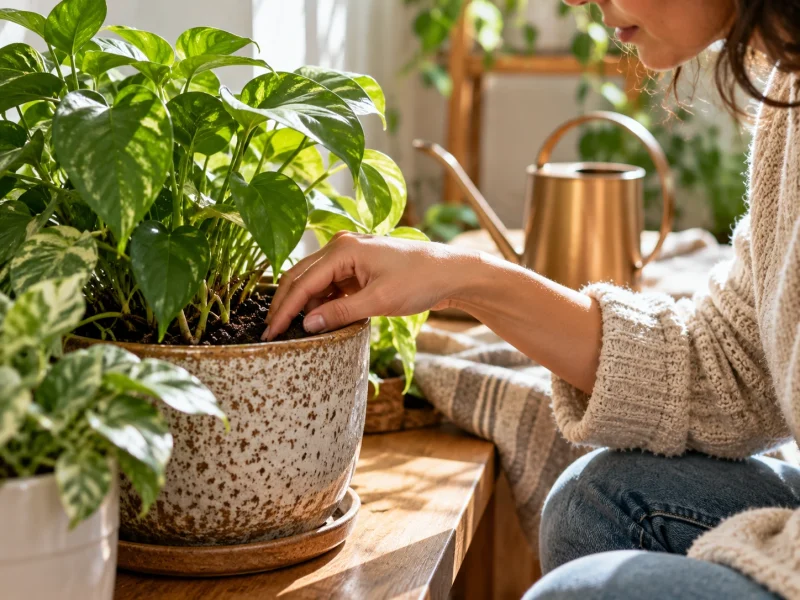
The finger test
Push a finger into the soil up to the second knuckle. It’s the most reliable test there is, and it’s free. What you find depends on the plant:
- Tropical foliage plants (Monstera, Philodendron, Pothos, Ficus): water when the top two or three centimetres are dry.
- Plants that like to stay moist (Calathea, Maranta, ferns, Spathiphyllum): water as soon as the top starts to dry, without waiting for the whole pot to dry out.
- Plants with reserves (Zamioculcas, Sansevieria, cacti, succulents): wait until the pot is dry all the way down.
The weight of the pot
Lift the pot just after a good watering: it’s heavy. Lift it a few days later: it’s noticeably lighter. With a little practice, your hand learns the difference and you can tell how moist it is without touching anything. It’s the most useful method for large pots, where your finger can’t reach the bottom.
The stick
A wooden skewer pushed to the bottom of the pot and pulled out tells you about the whole depth: clean and dry, the mix is dry; dark with soil stuck to it, it’s still moist.
How the soil looks
Dry potting mix is paler, crumbly and sometimes pulls away from the sides of the pot. Moist mix is darker and glossier. This varies with the mix, which is why it helps to compare it with how it looks just after watering.
The plant itself
Some plants warn you: Pothos and Spathiphyllum droop when they’re thirsty and perk up within a few hours of watering. But beware: drooping leaves can also signal too much water, when the roots are rotting. Before watering a wilting plant, always check the soil.
The moisture meters sold for a few dirhams are often unreliable. Your finger is better, and it never breaks down.
How to water well
- Water thoroughly, until water runs out of the drainage holes. Small daily sips only wet the surface and encourage shallow roots.
- Empty the saucer after a quarter of an hour. A pot sitting in water suffocates its roots.
- Use a pot with drainage holes. A planter without drainage is the number one cause of plants rotting in silence.
- Water in the morning if you can, with water at room temperature.
- If the potting mix has gone hard and water runs down the sides without soaking in, water from below: stand the pot in a tub of water for a quarter of an hour, then let it drain.
And if your water is very hard, see our article on tap water and plants.
The mistakes that keep coming up
- Watering out of habit, because it’s Sunday, without looking at the soil.
- Watering a wilting plant without checking it isn’t already soaked.
- Watering every plant on the same day, with the same amount, when a Zamioculcas and a Spathiphyllum have nothing in common.
- Blindly following the label. It gives an average for a home that doesn’t exist.
- Not adjusting in winter. We cover this in our article on autumn and winter care: the number one cause of death isn’t cold, it’s water.
If you really need a reminder
Some people like a ritual, and that’s fine. Just do it differently: set a reminder to look at your plants, not to water them. A weekly round, a finger in each pot, is enough to know which ones need water that day — and which can wait.
After a few weeks, you won’t need the reminder any more. You’ll know how to read your plants, and that’s what matters.
Unsure about a plant that’s declining? Drop by the studio at 6 Rue Zemmour in Rabat: we’ll look at the soil, the pot and the light together.