A plant that slowly turns yellow, white marks on the leaves, a pale crust forming on the surface of the soil. These are often put down to a lack of fertiliser or too much sun. In most cases, the cause lies elsewhere: it’s the water you use.
Tap water in Morocco is generally hard. It contains plenty of calcium and magnesium salts, which are perfectly healthy for us but cause a real problem for a potted plant watered with the same water for months on end.
What limescale really does to a potted plant
A pot is a closed environment. What goes in doesn’t come out, or hardly at all. With every watering you add dissolved minerals. The water evaporates or is taken up by the roots; the minerals stay.
After a few months, two things happen. The potting mix becomes more alkaline — its pH rises. And as it rises, some nutrients become chemically unavailable to the plant, even though they’re present in the soil.
Iron is the first to be affected. That’s why the most common symptom is iron chlorosis: young leaves turn yellow between the veins, which stay green. The pattern is distinctive, like a green network on a pale yellow background.
A plant can starve in soil full of food, simply because the pH stops it from getting to it.
On top of that comes the visible build-up: the whitish crust on the soil, rings on the leaves when you mist, marks on terracotta planters.
The most sensitive plants
They don’t all react the same way. Some cope; others visibly decline within a few months.
- Very sensitive — Calathea, Maranta, ferns, Alocasia, carnivorous plants, azaleas, camellias
- Moderately sensitive — Monstera, Philodendron, Ficus, Anthurium, Spathiphyllum
- Tolerant — Sansevieria, Zamioculcas, Pothos, cacti and succulents, Aspidistra
If your Calatheas are browning at the edges while your Pothos is thriving in the same room, you probably have your answer. It isn’t the air — it’s the water.
The solution that doesn’t work
You read everywhere that leaving water to stand overnight before watering is enough. That’s wrong — or rather, it’s true for one problem and useless for the other.
Leaving water to stand lets the chlorine evaporate. Chlorine is a dissolved gas, and it does escape into the air. That’s useful if your water smells strongly of swimming pool.
But limescale isn’t a gas. It’s a dissolved mineral salt. It doesn’t evaporate, it doesn’t disappear, and it doesn’t settle at the bottom of the container. After a night of standing, your water is exactly as hard as before. You’ve just lost the chlorine.
It’s a stubborn myth, and it explains why so many people do the right thing without ever seeing results.
The solutions that really work
Rainwater
It’s the best, and it’s free. Rainwater is naturally soft and slightly acidic — exactly what most houseplants prefer.
In Rabat, the rainy season runs roughly from October to April. That’s the time to set a container out on a balcony or terrace. A twenty-litre jerrycan filled two or three times over the winter covers the needs of around ten plants for months. Store it away from light, in a closed container.
Filtered water
A filter jug noticeably reduces hardness. It’s the simplest solution if you have neither balcony nor terrace, but there’s an ongoing cost in cartridges. Keep it for your most sensitive plants rather than the whole collection.
Demineralised water, with care
It’s available in supermarkets and it works. Be careful, though: it contains no minerals at all, including the ones the plant needs. If you use it on its own over time, you’ll need to compensate with regular feeding. Many people mix it half and half with tap water.
Flush the potting mix twice a year
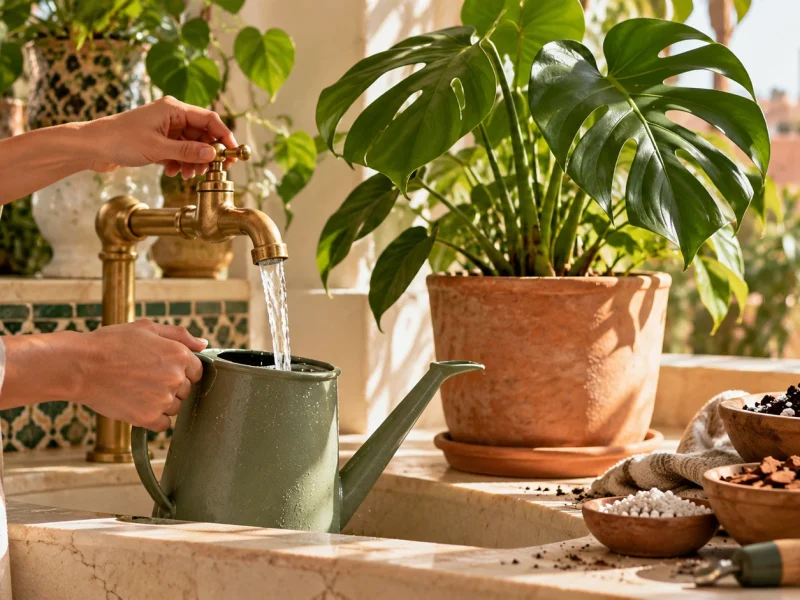
Whatever water you use, this should become part of your routine. Take the plant to the sink or the shower and run lukewarm water through the pot for a good minute, letting it all drain out through the drainage holes.
This washes out the accumulated salts — limescale and fertiliser residues. The potting mix gets a healthier fresh start. Do it in spring and autumn, on a healthy plant.
What if the damage is already done?
If the white crust is thick and the plant has been yellowing for several months, flushing alone won’t be enough. The potting mix is saturated.
You’ll need to repot: gently remove the old soil from the roots, rinse the root ball in lukewarm water and start again with fresh, free-draining potting mix. Do it in spring if possible, when the plant has the energy to bounce back. In autumn and winter it’s running slow and copes poorly with the operation.
Our Signature Potting Mix is made in Rabat with activated charcoal, precisely because it helps filter some of the minerals in tap water and limits build-up.
Got a question about a plant that’s declining? Drop by the studio at 6 Rue Zemmour in Rabat and we’ll take a look together. The diagnosis is free.