Cacti are thought of as indestructible, and yet plenty end up in the bin. Rarely from lack of water: they need very little. Almost always from too much, in a potting mix that keeps moisture around roots designed for soil that dries out within hours.
So the right potting mix is the first thing to get right. Here’s what it should contain, how to make it, and what you should never put in it.
Why a separate potting mix
Cacti and succulents come from arid regions, with poor, stony soils where water drains away at once. Their fine, shallow roots are adapted to this: they absorb quickly after rain, then stay dry.
In an all-purpose compost, which holds moisture, these roots stay wet for too long and rot. We compare potting mixes in our article on all-purpose compost and Signature Potting Mix: the one for cacti is the opposite.
The three qualities of a good cactus mix
- It drains very fast. Water should pass through the pot within seconds.
- It stays airy and doesn’t compact, even after several years.
- It’s low in organic matter. A little is enough; a lot holds too much water.
What it should contain
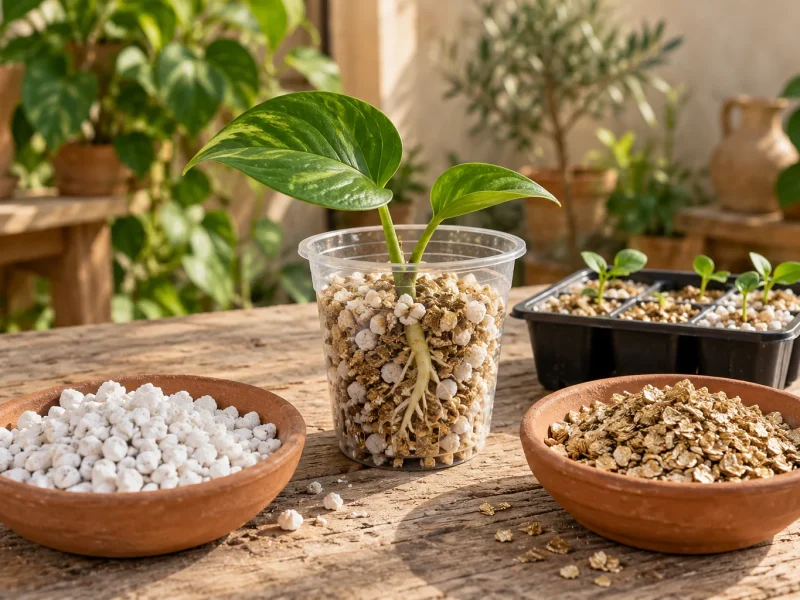
The base is mineral: pozzolana, perlite, fine gravel. To this you add a share of organic matter — potting soil or mature compost — which provides a little water retention and some nutrients. A common guideline is about two thirds mineral to one third potting soil, adjusted to the plant.
- Pozzolana provides lasting drainage and weight, without ever compacting.
- Perlite lightens and aerates.
- Potting soil or compost supplies the organic element.
A recipe to start with
There’s no universal recipe. Here are two starting points to test and adjust based on what you observe:
- Succulents such as Echeveria, Haworthia, Crassula: one part potting soil, one part pozzolana, one part perlite.
- Desert cacti: one part potting soil, two parts mineral (pozzolana and perlite in equal amounts).
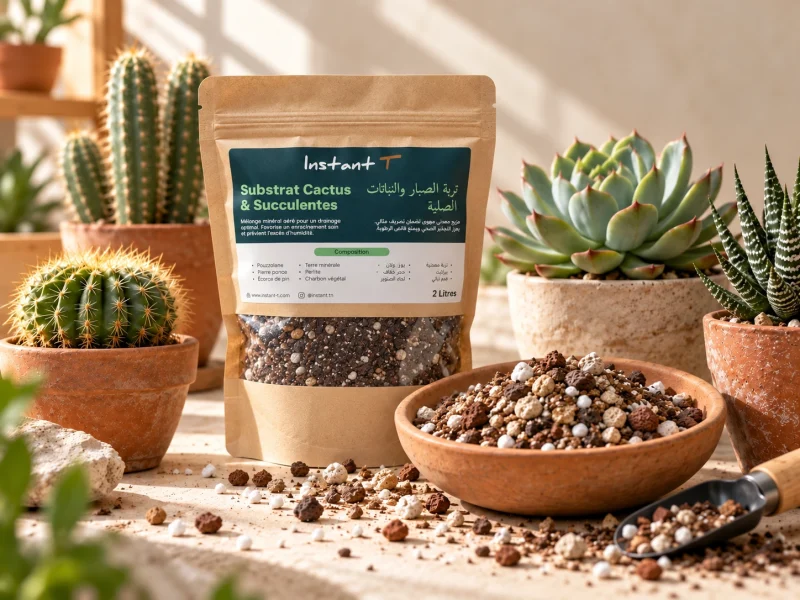
If you’re only potting one or two plants, the ready-to-use mix is simpler. For several pots, mixing your own works out cheaper and can be fine-tuned.
What not to use
- Beach or sea sand: it contains salt, which is toxic to roots, and it compacts.
- Fine builder’s sand: its grains fill the pores and the mix sets hard as it dries.
- Garden soil: too heavy, it compacts in a pot.
- All-purpose compost on its own: it holds far too much water.
Repotting a cactus or succulent properly
- Choose a pot with drainage holes, preferably terracotta, which lets the mix breathe.
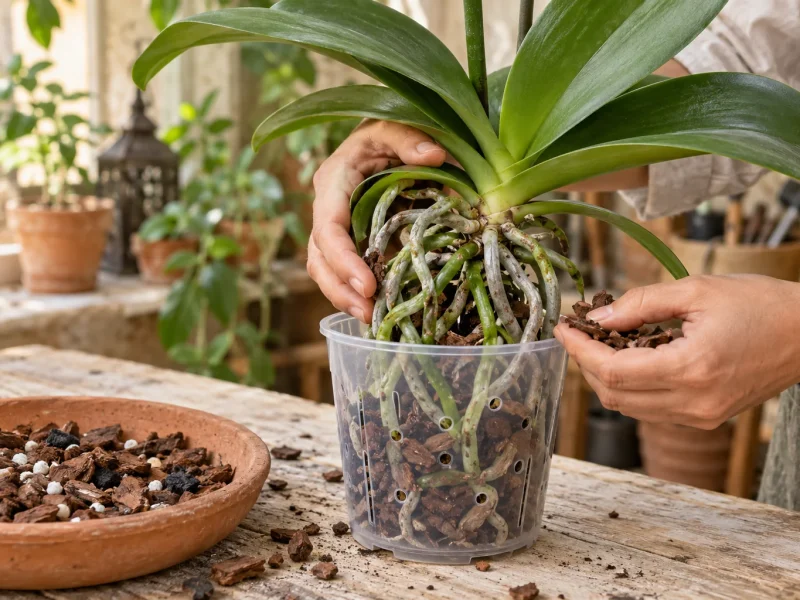
- Let the plant dry out before taking it out of its pot, and gently shake off the old mix.
- Set it in place and fill in with the new mix, without pressing it down too hard.
- Spread a thin layer of pozzolana on the surface: it reduces evaporation and keeps the base of the plant dry.
- Wait a few days before the first watering: small wounds on the roots have time to heal.
Our complete repotting guide details the steps for other plants.
Cactus or succulent: slightly different needs
They all get lumped together, but these plants don’t all have the same tolerance.
- Desert cacti and succulents with thick, powdery leaves (some Echeverias) need the most mineral, driest mix.
- More tolerant succulents (Haworthia, Crassula, Sedum) accept a little more potting soil, and so a little more water retention.
- Euphorbias and plants with water reserves (Zamioculcas, Sansevieria) are happy with a free-draining mix without being quite as demanding.
If in doubt, start with a very free-draining mix: it forgives a watering mistake better than a mix that’s too rich.
How to tell if your potting mix is right
A simple test, no equipment needed: water the pot and watch.
- The water should pass through within seconds and come out of the drainage holes. If it sits on the surface, the mix is too dense.
- The mix should dry out within a few days, not a few weeks.
- No crust, moss or green algae should form on the surface: these are signs of permanent damp.
- You should be able to push a finger in without resistance, even months after repotting.
If your mix fails these tests, repot. In the meantime, water less often and cover the surface with a layer of pozzolana: it helps it dry faster.
Watering and light complete the potting mix
A good potting mix is no use if you water by the calendar. Water only when the mix is dry all the way down the pot — see when to water — and much less in winter.
These plants also need plenty of light, more than most others. In a corner that’s too dark, they stretch and lose their shape and colour. Our guide to light levels helps you place them.
Our cactus and succulent mix is mineral and free-draining, designed for these plants. Drop by the studio at 6 Rue Zemmour in Rabat to talk it through.