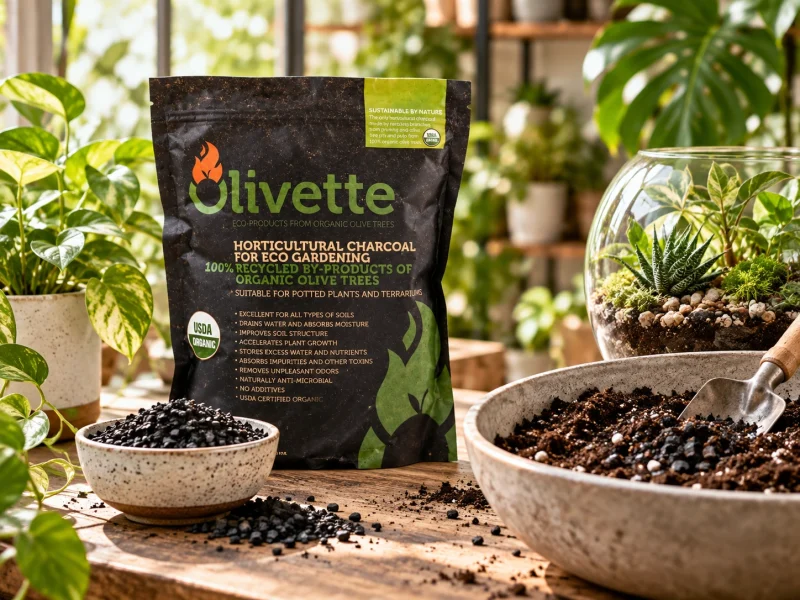
The word is showing up more and more on bags of potting soil, with promises ranging from “living soil” to “exceptional growth”. We use it in our Signature Potting Mix, and we’re preparing to launch our own brand, Olivette Biochar. In other words, we know it well — and we’d rather tell you what it actually does, without the magic.
What it is, and what it isn’t
Biochar is a plant-based charcoal made by heating biomass (wood, fruit stones, crop residues) to a high temperature with very little oxygen. This process is called pyrolysis. Instead of burning, the material turns into a solid, black, light and very porous form of carbon.
It shouldn’t be confused with barbecue charcoal, which often contains binders and lighting agents, nor with activated charcoal, which is further treated to trap molecules and used in filtration. Biochar is intended for soil.
The idea isn’t new. In the Amazon, dark soils called terra preta, enriched centuries ago with charcoal and organic waste, are still far more fertile today than the land around them. Modern biochar is their heir.
What it does in a pot
Its secret is its structure. A particle of biochar is riddled with tiny pores: for the same volume, its surface area is enormous. This has several effects.
- It holds water in its pores and releases it gradually, smoothing out the swings between waterings.
- It holds nutrients on its surface that would otherwise be washed out through the drainage holes.
- It keeps the potting mix airy. Unlike organic matter, which breaks down and compacts, biochar is very stable: it keeps its structure for years.
- It shelters microbial life. Its pores are a refuge for the useful bacteria and fungi in the potting mix.
- It locks in carbon. Instead of returning to the atmosphere as the plant material decomposes, the carbon stays stored in a very stable form.
What it doesn’t do
This needs saying clearly, because it’s where the promises go off the rails.
- It isn’t a fertiliser. Biochar on its own provides almost no usable nutrients.
- It doesn’t replace good watering or good light. A badly placed plant won’t be saved by an additive.
- Its effect is modest in a potting mix that’s already good. In a 2022 study carried out on a quality potting mix, adding 4% biochar increased water-holding capacity by around 21%, without any significant improvement in the growth of the plants tested. It mainly helps poor mixes, ones that drain too fast or ones that compact.
The point many people forget: it needs “charging”
New biochar is “empty”: its pores contain neither nutrients nor micro-organisms. Mixed straight into potting soil, it can at first hold some nutrients for itself rather than for the plant.
You avoid this by charging it before use: leave it to soak for one to three days in compost tea or diluted organic fertiliser, or mix it with compost. It then fills up with nutrients and micro-organisms and becomes a reservoir rather than a competitor. That’s one reason it is naturally paired with compost in a mix — we come back to this in our article on compost. Our liquid compost tea can be used for this.
What dose?
Recommendations vary by source and type of biochar, but the most common guideline for potted plants is 5 to 10% of the volume of the mix. Some mixes contain more, up to around twenty per cent, but then you need to know your biochar well.
Beyond that, side effects appear. A study on flower pots found that with 15% biochar or more, flowering decreased: the biochar had raised the pH and reduced the availability of nitrogen and phosphorus. The principle is simple: start low.
Watch the pH, especially with Moroccan tap water
Depending on the raw material and the production temperature, a biochar is neutral or, more often, alkaline. That’s something to watch here: our tap water is already hard, and it gradually makes potting mix more alkaline. Combining a very alkaline biochar with hard water isn’t ideal for plants that prefer a slightly acidic mix.
If in doubt, choose a biochar whose maker states its pH, and stick to moderate doses.
How to recognise a quality biochar
- A known raw material: untreated wood or biomass, with no paint, glue or chemical residues.
- A controlled particle size: neither fine dust that clogs the mix nor large chunks unsuited to a small pot.
- A stated pH, and ideally analyses available. Some biochars are certified, for example under the European Biochar Certificate.
- Genuine pyrolysis: wood simply burned in the open air doesn’t have the same properties.
In practice, for your plants
Biochar is mixed in when repotting, through the potting mix. Sprinkling it on the surface of an established pot does very little: it will only work its way down very slowly.
It suits most houseplants at moderate doses. For cacti and succulents, which want a very free-draining mix, use little or none, precisely because it holds water.
A potting mix containing biochar, compost or vermiculite holds more water than a mineral mix, which changes the watering rhythm. The right answer isn’t a schedule, it’s touching the soil — which is the subject of our article on when to water.
We use biochar in our Signature Potting Mix and are preparing to launch Olivette Biochar. To choose the right potting mix for your plants, see all-purpose compost or Signature Potting Mix, or drop by the studio at 6 Rue Zemmour in Rabat.