Under the trees of a forest, nobody adds fertiliser. Leaves fall, decompose and feed a soft, dark, sweet-smelling soil. Compost is that recipe, sped up and bagged: plant matter transformed into a soil improver that enhances any soil or potting mix.
It is also, increasingly, the answer to a problem horticulture often prefers to keep quiet about: peat. We replaced it with compost in our Signature Potting Mix, and we’re preparing to sell our own compost. Here’s why.
What compost is
Compost is the result of the controlled decomposition of organic matter — garden waste, plant residues — by micro-organisms, in the presence of oxygen. The heap heats up during the active phase, which sanitises it, then cools and matures.
A successful compost no longer looks like its ingredients: it’s a brown, crumbly material that smells of the forest floor. It shouldn’t be confused with potting soil, which is a blend of several components: compost is one ingredient.
Compost, potting soil, humus, earth: making sense of it all
- Compost: decomposed organic matter. It’s a soil improver, an ingredient.
- Potting soil: a ready-to-use blend for growing (compost, fibres, mineral materials…). Compost is one of its components.
- Humus: the stable organic matter in soil, which changes very slowly. Mature compost comes close to it.
- Garden soil: the top layer of the ground. Too heavy for pots, it compacts and may contain seeds and pests: we don’t recommend it indoors.
- Vermicompost: the product of earthworms. Fine, rich and gentle.
What it does for plants
- Organic matter, which gives structure to soil or potting mix. It lightens heavy soils and gives body to sandy ones.
- Better water retention, invaluable in a hot climate: the soil holds on to water instead of letting it drain away.
- Slow-release nutrients (nitrogen, phosphorus, potassium, trace elements), at the pace of biological activity.
- Microbial life, which transforms these nutrients and protects the roots.
- A buffering effect that evens out swings in moisture and nutrition.
It reduces the need for fertiliser. It doesn’t eliminate it: for demanding plants, a supplement is still useful — see our guide to organic fertiliser.
In indoor pots
Compost goes into a potting mix as one ingredient among others, rarely on its own. It usually makes up between 10 and 30% of the volume of the mix. On its own it would be too dense, hold too much water and risk suffocating the roots.
Compost for indoor use must be mature and sieved. Young compost releases ammonia that burns roots, gives off odours and attracts the tiny gnats that hover around pots.
How to recognise mature compost
- It smells of damp earth and forest, never of ammonia or rot.
- It’s dark brown, crumbly and uniform.
- You can no longer recognise the original ingredients (no whole leaves, no pieces of fruit).
- A simple test: sow some cress seeds in a little moist compost. If they germinate normally within a few days, the compost won’t burn your plants.
In the garden, in planters and on the terrace
In a hot, dry climate, organic matter in the soil breaks down quickly and disappears: soil that doesn’t receive any becomes poor and dries out. Compost addresses this problem.
- At planting time: mixed into the soil of the planting hole and planters.
- As a soil improver: a layer of a few centimetres raked into the surface in spring and autumn.
- As a mulch: spread around the base of plants, it feeds slowly and reduces evaporation.
- In balcony planters: added to potting soil to give it more body.
The problem with peat
Peat has been the star ingredient of commercial potting soils for decades: light and fine, it holds water very well and is practically sterile. It forms in peat bogs, wetlands where dead plants, underwater and without oxygen, decompose so slowly that they accumulate over thousands of years.
That detail changes everything. According to the IUCN, peatlands cover around 3% of the world’s land area but store more carbon than all the world’s forests combined — roughly twice as much as forest biomass. That carbon stays locked away as long as the peatland stays waterlogged.
To extract peat, the bog is drained. The carbon is then exposed to the air and returns to the atmosphere as CO₂. Drained peatlands, which make up less than 0.5% of land, are responsible for around 5% of global human-caused CO₂ emissions, according to the IUCN. And a stripped peat bog doesn’t regenerate within a human lifetime: what built up over millennia disappears in a few years.
Horticulture isn’t the only cause — agriculture and forestry weigh more heavily — but potting soils are a use in their own right. And it’s a use we know how to replace.
How peat is replaced
There’s no single ingredient that does everything peat does. It’s replaced by a blend, in which each component plays a role:
- Mature compost provides organic matter, nutrients and water retention.
- Coco coir and chips provide aeration and good water retention — see our coco chips.
- Horticultural biochar holds water and nutrients and gives the mix structure — see our dedicated article.
- Bark adds body and aeration — see our bark chips.
- Perlite, vermiculite and pozzolana regulate drainage and aeration.
A peat-free potting mix behaves a little differently: depending on the formula, it may dry faster or hold more moisture. That’s one more reason to touch the soil rather than follow a schedule — see when to water. Plants that like an acidic mix also need particular attention, which is solved with other components.
A starting mix for your houseplants
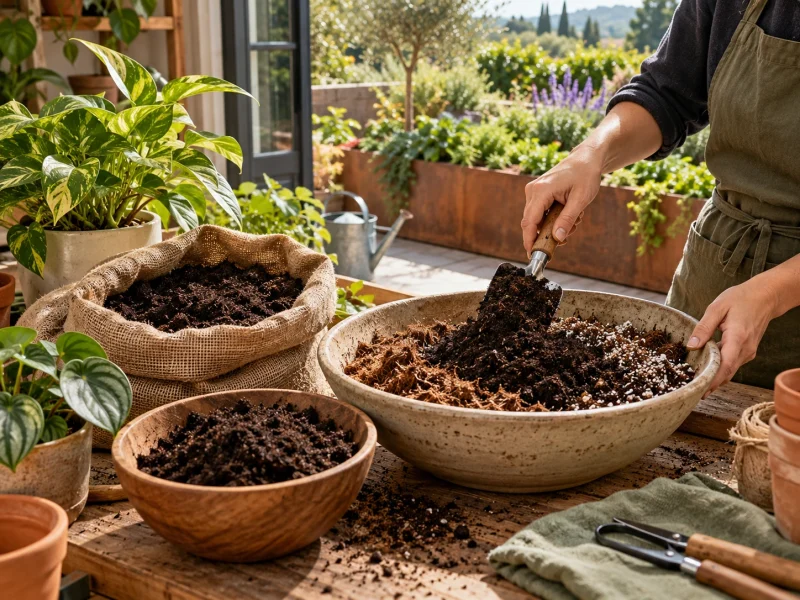
There’s no universal recipe, but for foliage plants a common starting point is roughly equal parts mature compost, fibres (coco, fine bark) and draining material (perlite, pozzolana), with a little charged biochar added.
Then adjust according to the plant: more draining material for plants that dislike wet feet, more fibre and compost for those that like to stay moist. It’s a starting point to test, not a dogma. Watch how the mix dries, and adapt.
Our choice at the studio
We use compost in our Signature Potting Mix in place of peat, and horticultural biochar for structure. At the same time, we’re preparing to sell our own compost, and will publish its specifications at launch. To choose the right potting mix for your plants, see all-purpose compost or Signature Potting Mix.
Choosing a good compost
- A clear origin: clean plant waste, with no plastic, glass or chemical residues. Be wary of poorly sorted composts made from municipal waste.
- Guaranteed maturity: the maker should be able to tell you how long it has matured.
- A sieved texture, especially for use in pots.
- Proper storage: cool and moist, never dried out or waterlogged.
Four misconceptions about compost
- “It smells bad and attracts insects.” Mature compost smells of earth and attracts no more than potting soil does. Problems come from young or overly wet compost.
- “It’s full of weed seeds.” Compost that has heated up properly destroys most of them. That’s why you choose compost made by a controlled process.
- “You need tonnes of it.” For a pot, a handful is enough. In the garden, a few centimetres a year.
- “It replaces potting soil.” No: it’s an ingredient, not the whole thing.
Making your own compost
If you have a garden or a large balcony, it’s simple in principle: alternate brown materials (dry leaves, cardboard, straw) with green materials (peelings, grass clippings, vegetable scraps), keep the heap as moist as a wrung-out sponge and turn it from time to time to aerate it. Within a few months, depending on the heat, decomposition does the rest. Avoid meat, fish and dairy products. In an apartment, a wormery does the same job on a small scale.
We use compost in our Signature Potting Mix and are preparing to launch our own compost. For your repotting, drop by the studio at 6 Rue Zemmour in Rabat.