A plant in the garden draws its nutrients from a wide area of soil. A potted plant has a few litres of potting mix, and its reserves run out within a few months. After that, it needs topping up. That’s the job of fertiliser.
The question is which one, when and how. This article covers the subject and describes the two products we develop at the studio: a compost tea for the roots and a seaweed-based feed for the foliage.
Before adding fertiliser: the order of priorities
Fertiliser is a supplement, not a cure. A yellowing plant is far more often the victim of overwatering or a lack of light than of a deficiency. Check in this order:
- Light — see our guide to light levels.
- Watering — see when to water.
- The potting mix and the water, which is often hard — see tap water.
- Only then, nutrition.
Feeding a badly placed or waterlogged plant only makes things worse.
What fertiliser contains
Labels show three numbers, the N-P-K balance:
- Nitrogen (N) feeds foliage and growth.
- Phosphorus (P) supports roots and flowering.
- Potassium (K) strengthens the plant’s overall resilience.
On top of these come trace elements (iron, magnesium, manganese, zinc…), needed in very small amounts but essential. Iron, for example, can be present in the potting mix without being usable by the plant when the pH is too high: that’s iron chlorosis, common with hard water.
Organic or mineral?
A mineral fertiliser (synthetic) provides nutrients that are immediately available, in precise quantities. Its drawback: they are salts. Even a slight overdose builds up in the pot, burns the roots and leaves a white crust.
An organic fertiliser provides nutrients in a form that must first be broken down by the micro-organisms in the potting mix. So it works more gradually, feeds soil life as well as the plant, and carries less risk of burning. On the other hand, it’s less precise, and its effectiveness depends on biological activity in the mix — and so on temperature.
Neither is “better” in itself. But for plants living in your living room, with a small volume of potting mix, organic is more forgiving.
Compost tea: feeding the roots
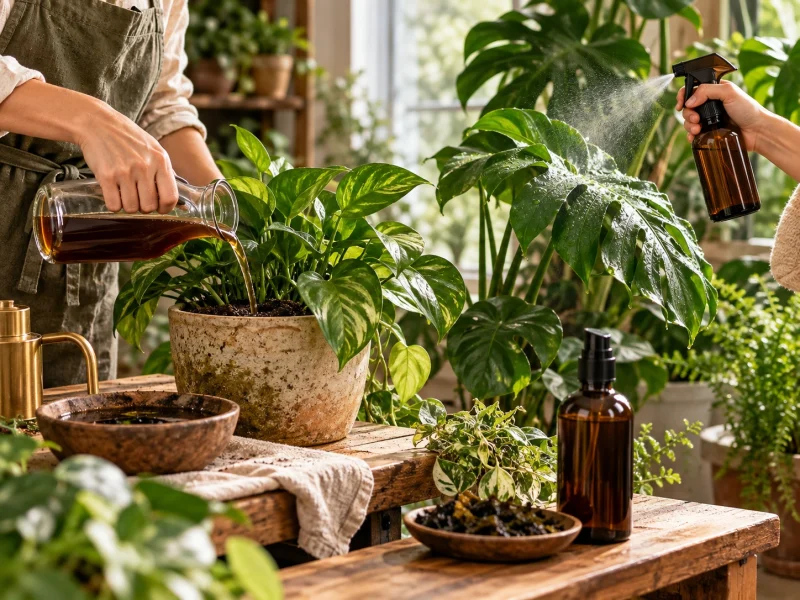
Compost tea is mature compost steeped in water. It draws out the soluble nutrients in the compost and some of its micro-organisms. It’s applied when watering, at the base of the plant: it’s a root feed.
It provides soluble organic matter, nutrients and micro-organisms that benefit the potting mix. Its effect is gentle and long-lasting. It’s also what’s used to “charge” new biochar before mixing it into potting soil — see our article on biochar.
Our liquid compost tea is designed for this. It’s a living product: store it away from heat and sunlight, and dilute it in your watering water — 8 pumps per litre, after shaking the bottle.
Seaweed: supporting the foliage
Seaweed extracts contain trace elements, sugars and various compounds that help the plant cope better with stress — heat, transplanting, changes in light. They are known as biostimulants.
An important point: they aren’t a complete meal. Their nitrogen, phosphorus and potassium content is low. They complement basic nutrition; they don’t replace it.
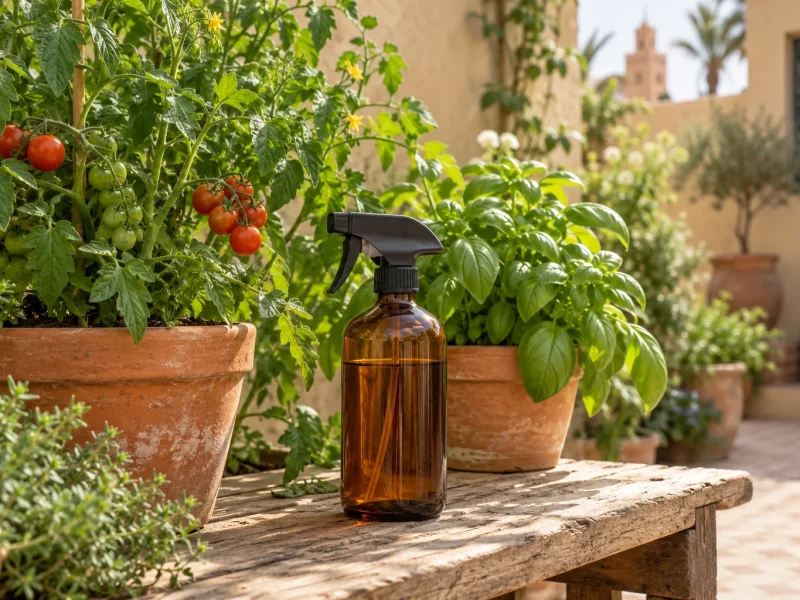
Our natural seaweed foliar feed is ready to use and applied as a spray: it’s a foliar feed.
Root or foliar?
The two don’t do the same job.
- Root feed goes in with the watering and feeds the plant through the potting mix. It’s the foundation, the basic supply, with a lasting effect.
- Foliar feed is sprayed onto the leaves, which absorb it directly. The effect is fast but short-lived. It serves as a boost or to correct a trace-element deficiency, not as the main source of food.
The two work very well together: compost tea for the foundation, seaweed for the foliage.
How to spray a foliar feed
- Early in the morning or late in the day, never in full sun: the droplets heat up and scorch the foliage.
- On the top and underside of the leaves: most of the stomata — the tiny openings through which the plant absorbs — are on the underside.
- As a fine mist, on a healthy plant — not on a parched plant or one under heat stress.
- Avoid wetting plants with hairy or powdery leaves (African violets, some succulents): they mark and don’t cope well with moisture on their foliage.
- Protect your furniture: products of natural origin can leave marks.
When and how often
- During the growing season, from spring to late summer. A resting plant doesn’t use what you give it.
- Stop in autumn. As we explain in our autumn and winter guide, feeding a plant that isn’t growing builds up salts that burn the roots.
- Small doses, regularly, rather than a large dose occasionally. Always follow the manufacturer’s dilution, and if in doubt, underdose.
- Never on dry potting mix: water with plain water first.
- Not on a sick or freshly repotted plant. Fresh potting mix already contains nutrients: wait a few weeks.
Recognising a deficiency… or an excess
A deficiency
- The older leaves gradually pale and yellow: often a lack of nitrogen.
- Yellow young leaves with veins that stay green: a lack of iron, very often linked to the pH of the potting mix and to limescale rather than a genuine absence of iron.
- Slow growth and small leaves, despite good light and good watering.
An excess
- Brown, dry leaf tips.
- A white or yellowish crust on the surface of the potting mix (don’t confuse it with limescale, which looks very similar).
- A plant wilting even though the soil is moist: the roots are burnt.
If you’ve overdosed, flush the potting mix: run plenty of lukewarm water through the pot and let it all drain away, several times. Stop feeding for several weeks.
By type of plant
- Foliage plants (Monstera, Ficus, Philodendron, Pothos): regular feeding during the growing season, with a nitrogen-rich fertiliser. Root feed as the base, foliar feed as a supplement.
- Flowering plants (Anthurium, Spathiphyllum): a fertiliser slightly richer in phosphorus and potassium while in flower.
- Cacti and succulents: very little, only during the growing season, at a reduced dose. They naturally live on poor soils.
- Bonsai: a tiny volume of potting mix, so regular, well-measured feeding. Our ready-to-use seaweed foliar feed also suits bonsai, alongside feeding at the roots.
- Carnivorous plants: never fertilise their potting mix — it kills them.
The most common organic fertilisers
- Compost and compost tea: a gentle supply that also feeds life in the potting mix.
- Worm castings (vermicompost): fine, rich and very gentle on roots.
- Insect frass: rich in nutrients, without the smell of animal-based fertilisers.
- Seaweed extracts: trace elements and biostimulants, as a supplement.
- Animal-based fertilisers (guano, hoof and horn, bone meal): effective, but they smell strong. Best kept for outdoor plants.
Coffee grounds, peelings, cooking water: do they work?
These tips do the rounds a lot. The reality is more nuanced.
- Coffee grounds left on the potting mix often go mouldy. It’s better to add them to compost, in small amounts.
- Peelings buried in a pot rot where they are and attract fungus gnats. Compost them first.
- Vegetable cooking water, unsalted and cooled, does no harm, but provides very little.
Why not home-made compost tea?
It’s possible, but demanding: you need perfectly mature compost, unchlorinated water and aeration during preparation. Badly made, compost tea can encourage unwanted bacteria instead of supplying good ones. It’s a product best bought from someone who has mastered it, or prepared with rigour.
Other organic options
Insect frass is another organic fertiliser, rich in nutrients. Our shop offers a natural frass fertiliser for indoor and outdoor plants.
Precautions
“Organic” doesn’t mean risk-free. Keep fertilisers out of reach of children and pets, wash your hands after use, and never mix several products yourself. A living product like compost tea should be stored away from heat and used within the stated time.
Our fertilisers and care products are available at the studio, 6 Rue Zemmour in Rabat, and online: compost tea root feed, seaweed foliar feed and black soap for plants. Unsure what to do? Bring your plant in and we’ll look together.