In front of a shelf of potting soils, every bag looks the same: a brown background, a photo of green leaves, a promise of “radiant plants”. The difference is on the label, and it’s the part people read least. A bag of potting soil isn’t a trivial purchase: it’s your roots’ home for the next one to three years. Here’s how to decode what’s written — and what should be.
Guide written by the Instant T studio in Rabat, updated in October 2026.
At a glance
A good potting soil label lists its components in full, says whether it contains peat and in what proportion, gives the volume in litres, states the pH and whether there’s any added fertiliser, and names a manufacturer and an origin. Be wary of vague terms (“plant soil”, “organic matter”) and words that sound good but guarantee nothing (“natural”, “eco-friendly”).
The eight points to check:
- The product name: potting soil, growing medium, soil improver, fertiliser? They’re not the same thing.
- The composition, component by component.
- Peat: whether it’s there, and under what name.
- Added fertiliser: how much, and for how long.
- The pH.
- The volume in litres, and the price per litre.
- The claims (“organic”, “peat-free”, “natural”) and what they guarantee.
- Manufacturer, origin and storage.
Contents
- Potting soil, growing medium, soil improver, fertiliser: what’s what?
- The composition: the most important point
- Peat, sphagnum, peat moss: spotting peat
- Added fertiliser: how much, and for how long?
- pH: why it matters
- Volume: litres, not kilos
- Claims: what they guarantee, and what they don’t
- Manufacturer, origin, storage
- What the label doesn’t say: inspecting the bag
- How to choose by the label
- Frequently asked questions
- Also worth reading
Potting soil, growing medium, soil improver, fertiliser: what’s what?
These words don’t mean the same thing, and confusing them leads to poor purchases.
| Word | What it is | Example |
|---|---|---|
| Potting soil | A ready-to-use mix for repotting | Potting soil for foliage plants |
| Growing medium | A broader term: any growing medium, ready to use or to be mixed | Cactus mix |
| Soil improver | An ingredient that improves the structure of a mix, without necessarily feeding | Perlite, pozzolana, coco chips, compost |
| Fertiliser | A product that supplies nutrients | Compost tea, foliar feed |
| Garden soil | The unprepared top layer of the ground | To be avoided in pots |
The roles of each ingredient are described in our guide to soil improvers and in the complete guide to potting mixes.
The composition: the most important point
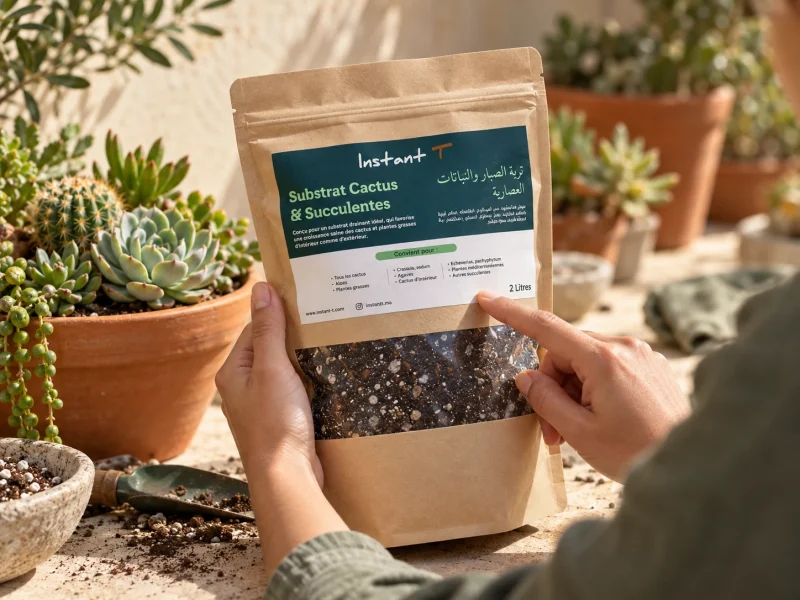
A useful label lists each component. It says, for example, “green waste compost, coco fibre, pine bark, perlite” rather than “organic and mineral matter”. The information varies a great deal from one bag to another: some detail everything, others almost nothing.
What to look for:
- The components and their proportions (as a percentage or by volume), as far as possible.
- Materials that give structure: coco fibre, bark, perlite, pozzolana, vermiculite. Without them, potting soil compacts.
- Materials that feed and retain: compost, biochar, fibres.
- Clean materials: “green waste compost” is reassuring; “municipal waste compost” less so, as it can contain particles of plastic or glass.
Warning signs: no list of components; “plant soil” or “soil” as the main component; no proportions; a photo of a lush plant but no information on the contents.
Peat, sphagnum, peat moss: spotting peat
Peat has been the base material of most shop-bought potting soils for decades: light, highly absorbent and almost sterile. It appears on labels under several names:
- peat, white peat, black peat;
- sphagnum peat, sphagnum (meaning the peat);
- peat, peat moss, sphagnum peat (on imported bags, in English).
Don’t confuse it with sphagnum moss (live or dried moss), which is the moss itself, living or dried, sold for orchids or terrariums.
| Criterion | Peat | Alternatives (compost, coco fibre, bark) |
|---|---|---|
| Lightness, water retention | Excellent | Good, depending on the mix |
| pH | Very acidic (often around 3.5 to 4.5), corrected by adding lime | Closer to neutral |
| Nutritional content | Almost none | Variable, richer with compost |
| When it dries out | Becomes water-repellent: water runs off without soaking in | Generally easier to rewet |
| Environmental impact | Extracted from peat bogs that store large amounts of carbon | Renewable materials or by-products |
We explained in detail why peat is a problem in our article on compost. It still has a technical use for acid-loving plants such as azaleas and hydrangeas. For the vast majority of houseplants, a peat-free mix works very well, as long as it’s well formulated.
Reading tip: a “peat-free” claim should come with a detailed composition. If the label says “peat-free” but lists nothing, the promise is worthless. Conversely, a bag that mentions peat isn’t necessarily bad: it’s information, to weigh up against your choice.
Added fertiliser: how much, and for how long?
Some potting soils are “enriched” with fertiliser. The label may show three numbers, such as NPK 14-16-18: these are the nitrogen (N), phosphorus (P) and potassium (K) contents of the fertiliser added to the mix. On potting soil, they’re often expressed in kilos per cubic metre rather than as a percentage of the bag: check the unit given. The higher the values, the more fertiliser has been added.
- An enriched potting soil feeds for the first few weeks, usually four to six weeks. During that time you don’t need fertiliser: see our repotting guide.
- The small coloured beads you see in some mixes are slow-release fertilisers, usually synthetic. They’re neither good nor bad in themselves, but you should know they’re there.
- Fertiliser doesn’t replace light or good watering: see when to water.
A potting soil “without fertiliser” isn’t a bad potting soil: it lets you manage nutrition yourself, with an organic fertiliser when the plant is growing.
pH: why it matters
pH measures the acidity of the potting mix. It determines whether nutrients are available: at the wrong pH, iron, manganese or phosphorus become inaccessible, even if they’re present.
- For most houseplants, a pH of around 5.5 to 6.5 is right.
- A serious label states it, sometimes as a range.
- If your water is hard, as in most Moroccan cities, the pH of the potting mix rises over time: see tap water and your plants.
Volume: litres, not kilos
Potting soil is sold by the litre. A “10 kg” bag may contain little material if the soil is waterlogged. Always compare the price per litre.
For example, horticultural perlite costs 20 MAD per litre in the 1-litre size and 14 MAD per litre in the 5-litre size (70 MAD). The size changes the price per litre, but also the delivery cost, which weighs less on a large bag. The potting mixes in our shop come in 1, 2 and 5 litres (2 and 5 litres for Signature Potting Mix and the cactus mix).
Claims: what they guarantee, and what they don’t
| Claim | What it means | To check |
|---|---|---|
| “Organic” (certified) | Normally implies certification | Which body certifies it, and for what? |
| “Natural”, “100% natural” | No precise framework | The detailed composition |
| “Of organic origin” | Materials from living things (plant, animal) | The list of materials |
| “Peat-free” | No peat in the mix | The composition in full |
| “Chemical-free” | No synthetic fertilisers or additives | The list of components |
| “Eco-friendly”, “sustainable” | No precise framework | The facts that justify it |
| “Water-retaining”, “hydrogel” | Contains a polymer that swells and holds water | Useful for outdoor plants in summer, less so for tropical houseplants, where it can keep the mix too wet |
“Of organic origin” means “from living things”. It doesn’t mean “organic” in the certified sense. When in doubt, always go back to the list of components: that’s what the manufacturer is committed to.
Manufacturer, origin, storage
- A manufacturer’s name and address, so you know who to ask.
- An origin: local or imported. A product made near you has travelled less; either way, the origin should be stated.
- A date of manufacture or expiry, or at least a batch number.
- Storage conditions: keep the bag closed, away from heat and damp. An opened bag left open attracts gnats.
What the label doesn’t say: inspecting the bag
Once the bag is open, a few seconds are enough to judge what you’ve bought.
- The smell: it should remind you of damp earth or the forest floor. A smell of ammonia or rot signals immature compost: see how to recognise mature compost.
- The look: dark brown, crumbly, even. No white mould, no fragments of plastic or glass.
- The moisture: the mix should be slightly moist, neither soaked nor dusty.
- The handful test: squeeze a handful. It should hold a loose shape, then crumble without running. If it’s pasty, it’s too dense; if it doesn’t hold together at all, it’s too dry or too mineral.
How to choose by the label
| Your need | What the label should show |
|---|---|
| Repotting tropical foliage plants | A rich base and aerating components (fibres, bark, perlite) |
| Repotting cacti | A mostly mineral composition |
| Avoiding peat | A list of peat-free components, in full |
| Managing nutrition yourself | No added fertiliser, or an NPK figure stated |
| Comparing two bags | A volume in litres and a price per litre |
To go further on choosing a mix by plant, see which potting mix for which plant, and to compare an all-purpose mix with one designed for tropical plants, all-purpose compost or Signature Potting Mix.
Frequently asked questions
What does NPK mean on a bag of potting soil?
It’s the nitrogen (N), phosphorus (P) and potassium (K) content of the fertiliser added to the potting soil. It shows how enriched it is, and the unit (percentage or kilos per cubic metre) should be stated on the bag.
How do you spot peat on a label?
Look for the words “peat”, “white peat”, “sphagnum” (meaning the peat) or “peat moss”. If the composition isn’t listed, ask the seller or the manufacturer.
Is “peat-free” potting soil better?
Not automatically: it depends on what replaces it. A good peat-free mix combines compost, fibres and draining materials. A poor peat-free mix can compact or dry out. It’s the composition that counts.
All-purpose compost or potting soil for foliage plants?
All-purpose compost is versatile but often denser. Potting soil for foliage or tropical plants should in principle be airier. The composition tells you which is which: see all-purpose compost or Signature Potting Mix.
What pH for houseplants?
Around 5.5 to 6.5 for most. Acid-loving plants have different needs.
Does potting soil go off?
It doesn’t expire like food, but it ages: the nutrients run out and the structure compacts. A bag left open for several months attracts gnats. Keep it closed and dry.
Can you reuse old potting soil?
If the plant was healthy, you can mix it with mature compost and perlite to give it back some structure. If it was sick or infested, throw it away.
Should you add fertiliser to an already enriched potting soil?
Not for the first four to six weeks. After that, a light feed during the growing season.
Also worth reading
- The complete guide to houseplant potting mixes
- Compost: why it should replace peat
- All-purpose compost or Signature Potting Mix
- Biochar: what does it do in potting soil?
- Fertiliser for houseplants: compost tea and seaweed
Puzzled by a label? Send us a photo of the bag on WhatsApp at 06 61 05 26 38. The studio is at 6 Rue Zemmour, Aviation district, Rabat, Monday to Saturday, 11am to 3pm.