Root rot is one of the most common causes of houseplant loss, and it often comes from water that can’t escape. Hence all the drainage advice: clay pebbles at the bottom of the pot, gravel, crocks, pots without holes, saucers… a good deal of which is wrong. Here’s what really works, and why.
Guide written by the Instant T studio in Rabat, updated in October 2026.
At a glance
No, a layer of clay pebbles at the bottom of the pot doesn’t drain: it does the opposite, bringing standing water closer to the roots. What really drains is holes in the bottom of the pot, an airy potting mix through the full height of the pot and a saucer you empty.
- Pots without holes: keep them for use as cover pots. The plant stays in a nursery pot with holes, which you lift out to water.
- Saucers: empty within half an hour of watering.
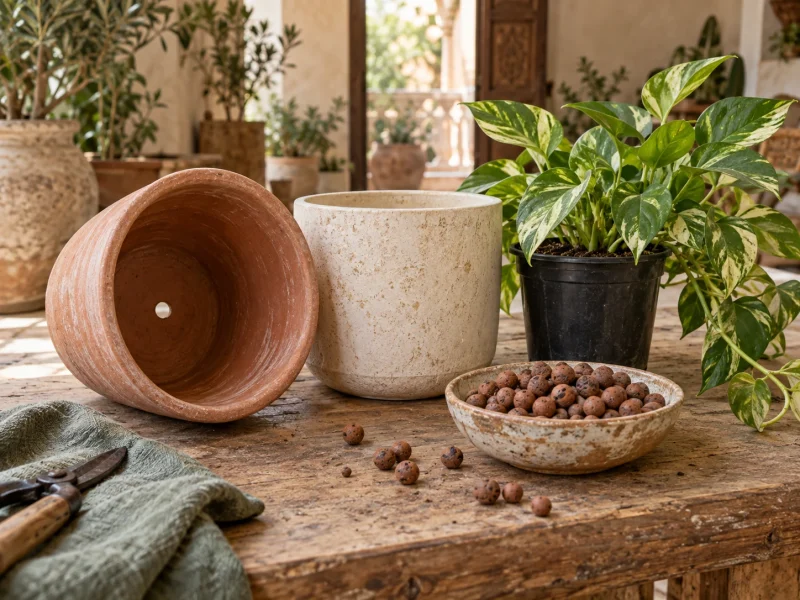
- Clay pebbles: useful mixed into the potting mix, as a surface mulch, or as a bed under the pot inside a planter. Not at the bottom of the pot.
- Self-watering planters: suited to plants that like to stay moist, not to cacti.
Contents
- Why drainage decides a plant’s health
- Does a layer of clay pebbles at the bottom of the pot drain?
- What are clay pebbles really for?
- The four real tools of drainage
- Can you keep a plant in a pot without a hole?
- Saucers: empty them or leave them?
- Self-watering planters: who are they for?
- How to tell if your drainage is good
- Saving a plant with “wet feet”
- Which drainage for which plant?
- And in a terrarium?
- Frequently asked questions
- Also worth reading
Why drainage decides a plant’s health
A root doesn’t just drink: it breathes. It needs oxygen, and oxygen circulates in the tiny gaps in the potting mix. When those gaps stay filled with water, the root suffocates, fungi move in and it rots.
Good drainage, then, means letting excess water run away after watering so that air returns to the mix. The signs of poor drainage are recognisable: potting mix that stays wet for days on end, lower leaves yellowing, soft stems at the base, a musty smell, tiny gnats around the pot, a green or white crust on the surface.
Does a layer of clay pebbles at the bottom of the pot drain?
No. The idea seems logical: with pebbles at the bottom, water would pass through the gaps between them and drain away quickly. In reality, water doesn’t behave like that.
Water moves through a fine potting mix by capillary action, a bit like a sponge. When it reaches the boundary between that fine mix and a coarse material (pebbles, gravel, crocks), it doesn’t pass through until the fine mix is saturated. So it builds up just above the pebble layer, in a waterlogged zone known as a perched water table. The result: this saturated zone, which always exists at the bottom of a pot, is raised by the full thickness of the pebble layer, and the aerated zone where the roots live shrinks by the same amount.
In other words, 5 cm of pebbles at the bottom of a 20 cm pot means 5 cm less potting mix and a saturated zone raised by 5 cm — closer to the roots. This has been documented notably by horticulturist Linda Chalker-Scott of Washington State University, who recommends a potting mix with no drainage layer and pots with holes (read her article).
The practical conclusion is the same as in our repotting guide: put nothing at the bottom of the pot except a small piece of mesh or a crock to cover the hole and hold the mix in.
What are clay pebbles really for?
Clay pebbles are useful. They’re light and porous, don’t break down, and absorb a little water to release it later. But not at the bottom of the pot.
| Use | Useful? | How |
|---|---|---|
| At the bottom of the pot “for drainage” | No | Creates a perched water table and shrinks the aerated zone |
| Mixed into the potting mix | Yes, in moderation | They lighten a mix that’s too dense; allow one part to four or five parts potting mix |
| As a surface mulch | Yes | Reduces evaporation, protects the crown, discourages gnats |
| As a bed under the pot, inside a planter | Yes | Keeps the pot above any leftover water; the water should never reach the bottom of the pot |
| In hydroponic or semi-hydro growing | Yes | A growing medium in water, for plants suited to it |
| As decoration | Yes | Hides the soil, with no effect on drainage |
If you want to improve drainage in a mix, think first of ingredients that blend through the whole volume: perlite, pozzolana, bark and coco chips. The role of each is detailed in our guide to soil improvers.
The four real tools of drainage
- A pot with holes. One or more good-sized holes in the bottom. It’s the basic requirement.
- An airy potting mix through the full height of the pot. Water should pass through the mix without sitting, within ten seconds or so at most. To choose one for your plant, see the complete guide to potting mixes.
- A pot of the right size. An oversized pot holds a mass of wet potting mix that the roots don’t use.
- Watering that adapts. The best drainage won’t fix watering that’s too frequent: see when to water.
Can you keep a plant in a pot without a hole?
Yes, but not as a growing pot. A decorative container with no hole works very well as a cover pot: the plant stays in a nursery pot with holes, which slips inside the decorative container. Lift out the inner pot to water, let it drain, then put it back. It’s the simplest, safest solution.
Our faux leather and jute planter is designed this way, with no drainage hole, for use as a cover pot only. Our Fez leather planter is made to hold a standard 13, 16 or 22 cm plastic pot.
| Solution | Risk | When to use it |
|---|---|---|
| Nursery pot with holes inside a cover pot | Low, if you empty the water at the bottom | General case, all plants |
| Drilling the decorative pot | Low, if the hole is big enough | Ceramic or terracotta, glazed or not; ceramic or glass drill bit, slow speed, under a trickle of water |
| Planting directly in a pot without a hole | High | Only with very careful watering and a tolerant plant; not recommended for beginners |
| Pebble layer in a pot without a hole | High | Avoid: water builds up with nowhere to go |
If you do plant in a container without a hole, water in small amounts several times rather than pouring a lot at once, and never give more than the mix can absorb. Check the bottom regularly by tilting the pot.
Terracotta pots
An unglazed terracotta pot lets water evaporate through its walls, which partly makes up for imperfect drainage. It dries faster than a plastic pot: adjust your watering accordingly. Cacti and succulents particularly like them, as we explain in our guide to cactus potting mix.
Saucers: empty them or leave them?
Empty them. A plant constantly sitting in water in its saucer draws that water up through the holes and keeps the bottom of its potting mix saturated. Empty the saucer within half an hour of watering.
Two exceptions: some waterside plants, such as papyrus (Cyperus), tolerate a permanent water reservoir; and you can deliberately water from below, standing the pot in a few centimetres of water for ten to thirty minutes and then taking it out. This method suits plants whose leaves dislike getting wet. If your water is hard, though, it leaves the salts at the surface: flush the mix from above from time to time, as we describe in the article on tap water.
Self-watering planters: who are they for?
Bottom-watering planters have a water reservoir in the base: the plant draws on it as it needs, letting you water less often. Our handmade ceramic planters are designed for watering from below, with a built-in saucer; the page for each size explains how to use it.
- They suit plants that appreciate steady moisture (Calathea, Maranta, ferns, Spathiphyllum), and absences of a few days.
- They don’t suit cacti, succulents or any plant that needs to dry out between waterings.
- Precautions: use an airy potting mix, let the reservoir empty from time to time rather than keeping it constantly topped up, and check that the bottom of the root ball isn’t permanently soaked.
How to tell if your drainage is good
The test is simple. Water the plant and watch:
- Water should soak in within ten seconds or so at most and come out of the holes. If it sits on the surface for more than about fifteen seconds, the mix is probably compacted or clogged.
- The potting mix should dry out within a few days to a week, not over several weeks. Touch it: see our watering advice.
- No musty smell and no green crust should appear on the surface.
| Symptom | Likely cause | What to do |
|---|---|---|
| Water sits on the surface | Compacted mix, blocked holes | Loosen the surface with a fork; if it persists, repot |
| Water runs through too fast and comes out clear | Dry root ball that has become water-repellent, or roots packed to one side | Soak the pot in water for ten to twenty minutes |
| Yellow lower leaves, soft stems at the base | Rotten roots | Take out the root ball, trim the rotten roots, repot |
| Gnats around the pot | Surface constantly damp | Let the surface dry, cover with pozzolana or pebbles |
| Green or white crust | Constant damp, limescale deposits | Scrape, aerate, adjust watering |
Saving a plant with “wet feet”
- Take out the root ball and look at the roots. Healthy ones are white or beige and firm; rotten ones are brown, soft or foul-smelling.
- Remove the soggy potting mix, shaking it off or rinsing it away gently.
- Cut off all the rotten roots with a clean tool, back to healthy tissue.
- Repot in fresh, airy potting mix, in a pot with holes, ideally slightly smaller than the old one. The steps are in our repotting guide.
- Water very little in the first week, put the plant in bright indirect light and don’t add fertiliser.
If more than half the roots are affected, the chances drop: take cuttings of whatever you can (healthy stems) while there’s still time.
Which drainage for which plant?
| Plant | Need | Potting mix and pot |
|---|---|---|
| Cacti, succulents | Very free-draining, dry between waterings | Very mineral mix, terracotta pot with holes |
| Tropical foliage plants (Monstera, Philodendron, Ficus) | Balance between moisture and air | Airy mix with bark or coco chips and perlite |
| Plants that like to stay moist (Calathea, ferns) | Steady moisture without stagnation | Rich mix with vermiculite or coco, pot with holes |
| Orchids | Very well-aerated roots | Bark, clear or slotted pot |
| Aquatic or marginal plants | Permanent water reservoir | Pot without drainage or with a full saucer |
For a precise choice by family, see which potting mix for which plant.
And in a terrarium?
A terrarium has no hole, and yet plants live in it. That isn’t drainage: the layer of gravel or pebbles acts as a safety reservoir and a visual divider, not as a way to remove water. To make it work, you water drop by drop with a spoon and choose suitable plants. It’s one of the techniques we teach in our workshops: see the terrarium workshops or, for a team, the terrarium and kokedama team-building workshop. If you’d prefer a terrarium ready to give, see our mini cylinder terrarium.
Frequently asked questions
Should you put clay pebbles at the bottom of a pot?
No. A layer of pebbles doesn’t drain any better: it raises the saturated zone that exists at the bottom of the pot. A pot with holes and an airy potting mix are enough.
Do gravel or broken crocks help drainage?
No, for the same reason as pebbles. A small crock or a piece of mesh only serves to cover the hole and hold the mix in.
Can a plant live in a pot without a hole?
In some cases, but the risk of rot is high. The safest option is to keep it in a nursery pot with holes, slipped inside a cover pot.
How do you drill a ceramic pot?
With a ceramic or glass drill bit, at slow speed, keeping a trickle of water on the drilling point to prevent overheating. If the pot is glazed, put masking tape over the drilling point to stop the bit slipping.
How long should water stay in the saucer?
Half an hour at most, then empty it. Plants that tolerate a permanent reservoir are the exception.
Do you need a saucer?
Yes, to protect your furniture, but you must empty it. A cover pot can do the same job, as long as you empty that too.
Why does water run straight through the pot?
Often the root ball has dried out and become water-repellent, or the roots have created a channel. Soak the pot in water for ten to twenty minutes to rehydrate the whole root ball. If it keeps happening, the potting mix is exhausted: it’s time to repot.
Is a self-watering planter good for my plants?
For plants that like steady moisture, yes, provided you use an airy potting mix. For cacti and succulents, no.
Also worth reading
- Repotting a houseplant: when, how and which potting mix
- The complete guide to houseplant potting mixes
- Perlite, vermiculite, pozzolana, coco chips: which to choose?
- When should you water your plants?
- Is tap water harming your plants?
Unsure about a plant’s drainage? Describe the pot and potting mix to us on WhatsApp at 06 61 05 26 38. The studio is at 6 Rue Zemmour, Aviation district, Rabat, Monday to Saturday, 11am to 3pm.