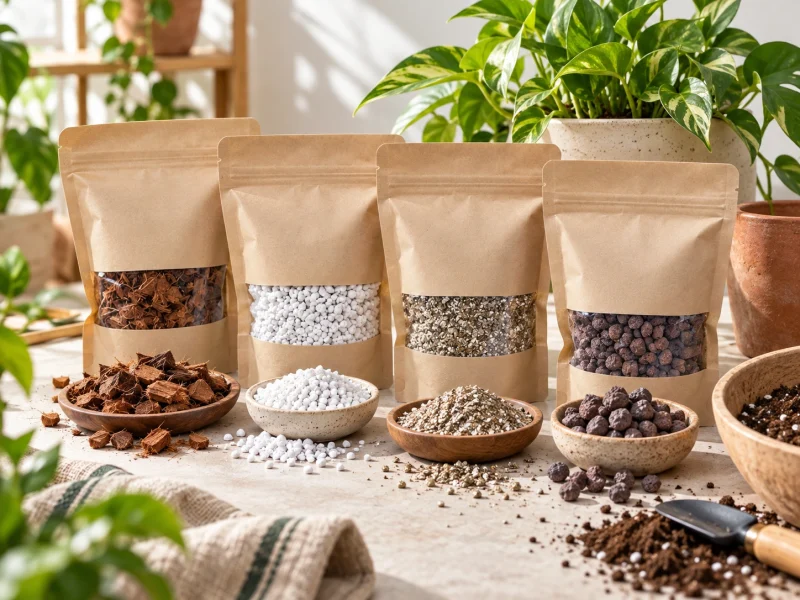
In a good potting mix, it isn’t the potting soil alone that makes the difference — it’s what you add to it. Four ingredients come up again and again: perlite, vermiculite, pozzolana and coco chips. They’re among our most requested products, and with good reason. But they’re often confused, even though their roles are completely different.
Two questions: water and air
A potting mix has to do two things at once: hold enough water for the roots to drink, and let in enough air for them to breathe. Too much water and not enough air: the roots rot. The reverse: the plant dries out.
Each of these four ingredients moves that slider in one direction. Choosing them means deciding which way you want to lean.
Perlite: aerating and draining
Perlite is a volcanic rock (a glass) heated to a high temperature, which puffs up into small, very light, porous white granules. It doesn’t break down, contains no nutrients and stays stable for years.
- It aerates the potting mix and stops it compacting.
- It drains: water passes through it quickly, which limits the risk of rot.
- It holds little water — that’s its limitation: on its own, it isn’t enough for plants that like to stay moist.
- It rises to the surface when you water — that’s normal. Moisten it before handling to keep dust down.
Our horticultural perlite is ideal for cuttings and light mixes.
Vermiculite: holding water and nutrients
Vermiculite is a mineral (a mica), also heated to a high temperature: it expands into light, accordion-shaped flakes. It does almost the opposite of perlite.
- It holds water and gradually releases it to the roots.
- It also holds on to some nutrients.
- It’s ideal for seedlings and cuttings, which need steady moisture.
- Its limitation: it compacts over time, and in excess it suffocates roots.
Our vermiculite is used as an addition to a potting mix, never on its own for plants that dislike humidity.
Pozzolana: lasting drainage
Pozzolana is a natural, porous, angular volcanic rock, crushed into small gravel. It’s heavy, doesn’t break down and doesn’t compact.
- It drains and aerates for the long term, without ever collapsing.
- Its pores hold a little water without retaining too much.
- It adds weight to mixes: useful for steadying a large pot with a tall plant.
- Spread on the surface, it makes a decorative mulch that reduces evaporation.
It’s the go-to ingredient for cacti and succulents. Our pozzolana is the base for them.
Coco chips: aerating while holding a little moisture
Coco chips are pieces of the husk that surrounds the coconut. They’re a renewable plant by-product that breaks down slowly.
- They aerate the potting mix and encourage rooting.
- They hold some moisture without making the mix soggy.
- They last much longer than a soil improver that breaks down quickly.
- Tip: soak them for a few minutes before use. They swell, and this washes out any salts.
Our coco chips pair well with compost to replace peat — we explain why in our article on compost.
All four at a glance
| Ingredient | Origin | Water | Air and drainage | Best for |
|---|---|---|---|---|
| Perlite | Expanded volcanic glass | Holds little | Excellent | Cuttings, light mixes, plants that dislike humidity |
| Vermiculite | Expanded mineral (mica) | Holds a lot | Fair, but compacts | Seedlings, cuttings, plants that like to stay moist |
| Pozzolana | Volcanic rock | Holds little | Excellent and long-lasting | Cacti, succulents, large pots that need steadying |
| Coco chips | Coconut fibre | Holds moderately | Good | Tropical plants, peat-free mixes |
Which mix for which plant?
- Tropical foliage plants (Monstera, Philodendron, Ficus): a base of potting soil or compost, coco chips for aeration, a little perlite.
- Plants that like to stay moist (Calathea, ferns, Spathiphyllum): a rich base, vermiculite or coco to hold moisture, and a little perlite so the mix doesn’t get soggy.
- Cacti and succulents: mostly mineral, so pozzolana and perlite with a little potting soil — or our ready-to-use mix. See our dedicated guide.
- Seedlings and cuttings: vermiculite and perlite, a fine, light mix.
- Large pots and tall, unstable plants: pozzolana for weight and stability.
The proportions depend on your base potting soil, your pot and your climate. Start with about one third of the ingredient, watch how the mix dries, and adjust. This also explains the watering rhythm: see when to water.
The mistakes that keep coming up
- Perlite on its own, or on the surface: it floats and washes away when you water.
- Too much vermiculite: the mix compacts and the roots run short of air.
- Dry coco chips mixed in as they are: they swell afterwards in the pot and can bring in salts.
- Too much draining material in a small terracotta pot: the mix dries out within days.
- Forgetting that these ingredients don’t feed the plant. They structure the potting mix; nutrition comes from compost and fertilisers — see our guide to organic fertiliser.
A word on where they come from
None of these ingredients is neutral. Perlite and vermiculite are mined and then heated to very high temperatures, which uses energy. Pozzolana is crushed rock. Coco chips are an agricultural by-product. That’s one of the reasons we’re increasingly combining compost and biochar in our Signature Potting Mix.
These ingredients are available at the studio, 6 Rue Zemmour in Rabat, and online. Not sure about a mix? Tell us your plant and your pot, and we’ll advise you.