There’s no such thing as a “good potting soil” that works for every plant. A Monstera, a Calathea, an orchid and a cactus have roots made for soils that have almost nothing in common. The right mix follows from a single question: how does this plant live in the wild? Here are the families most common in Moroccan homes, and the mix that suits each.
Guide written by the Instant T studio in Rabat, updated in October 2026.
At a glance
Choose the potting mix according to the plant’s native habitat: a rich, airy mix for tropical understorey plants (Monstera, Philodendron, Pothos), moister but without stagnation for Calatheas and ferns, bark for orchids, and a very mineral mix for cacti and succulents. The proportions below are starting points to adjust to your pot, your light and your watering rhythm.
Contents
- The reference table
- Why the potting mix depends on the plant
- Climbing aroids: Monstera, Philodendron, Pothos, Syngonium
- Alocasia and Anthurium
- Calathea, Maranta, Stromanthe
- Ferns and Spathiphyllum
- Ficus, Dracaena, Schefflera: indoor trees
- Peperomia, Pilea, Hoya: the semi-succulents
- Zamioculcas and Sansevieria
- Cacti and succulents
- Orchids
- Cuttings and seedlings
- Ready-to-use or mix your own?
- How to make your mix
- How to adjust for your situation
- How to tell the potting mix isn’t right
- Frequently asked questions
- Also worth reading
The reference table
Proportions by volume. “Rich base” means a quality indoor potting soil, which can be blended with sieved mature compost (around 10 to 30% of the volume of the base).
| Family | Examples | Starting mix | Why |
|---|---|---|---|
| Climbing aroids | Monstera, Philodendron, Pothos, Syngonium | 1 rich base, 1 bark or coco chips, 1 perlite | Aerial roots, used to leaf litter and bark |
| Alocasia, Anthurium | Alocasia, Anthurium | Ready-to-use mix, or 1 rich base, 1 fine bark, 1 perlite | Light, rich, moist without stagnation |
| Prayer-plant family | Calathea, Maranta, Stromanthe | 2 rich base, 1 coco chips or vermiculite, 1 perlite | Steady moisture, sensitive to salts |
| Ferns | Nephrolepis, Asplenium | 2 rich base, 1 coco chips, 1 perlite | Organic matter, moisture |
| Spathiphyllum | Peace lily | 2 rich base, 1 perlite | Tolerant, likes humidity |
| Indoor trees | Ficus, Dracaena, Schefflera | 2 rich base, 1 bark, 1 perlite or pozzolana | Structure, stability in large pots |
| Semi-succulents | Peperomia, Pilea, Hoya | 1 rich base, 1 perlite, 1 fine bark | Fine roots that dislike excess water |
| Plants with reserves | Zamioculcas, Sansevieria | 1 rich base, 1 perlite, 1 pozzolana | Rhizomes that rot if water sits |
| Cacti, succulents | Echeveria, Haworthia, desert cacti | 1 rich base, 1 pozzolana, 1 perlite | Very fast drainage |
| Orchids | Phalaenopsis | Bark, a few coco chips | Aerial roots that need air |
| Cuttings, seedlings | All | Vermiculite and perlite | Steady moisture, fine, light mix |
Why the potting mix depends on the plant
A potting mix does two things: holds water and lets air through. All plants need both, but in different proportions.
- A damp understorey plant (Calathea, fern) wants water available continuously, but not standing.
- A climbing rainforest plant (Monstera, Philodendron) has roots that cling to tree trunks: it needs air and a fibrous mix.
- An epiphytic plant (orchid) grows on trees, without soil: its roots die in potting soil.
- A desert plant (cactus) lives on mineral soils where water drains away at once.
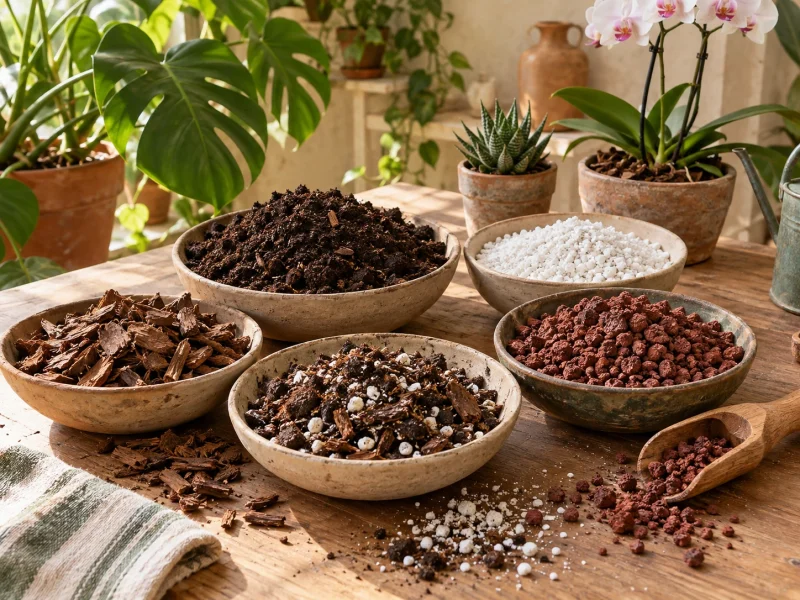
The ingredients, their properties and their limits are described in our guide to soil improvers and in the complete guide to potting mixes.
Climbing aroids: Monstera, Philodendron, Pothos, Syngonium
Recommended mix: one part rich base, one part fibres (coco chips or bark), one part perlite. Add a small handful of charged biochar if you have some: see our article on biochar.
These plants grow in tropical forests, where their roots cling to tree trunks and reach down into airy humus. In a pot, potting soil on its own compacts and holds too much water. Adding coco chips or bark and perlite keeps it aerated. For large Monsteras or Philodendrons, a little pozzolana weighs down and steadies the pot.
Alocasia and Anthurium
Recommended mix: our Signature Potting Mix, designed for these demanding plants. If mixing your own, aim for a light, rich mix that holds moisture without standing water: one part rich base, one part fine bark, one part perlite.
Alocasia is demanding: too dry and it loses its leaves; too wet and its rhizomes rot. Anthurium, originally an epiphyte, appreciates a very airy mix: give it more bark. For both, light and watering matter as much as the mix: see light.
Calathea, Maranta, Stromanthe
Recommended mix: two parts rich base, one part coco chips or vermiculite, one part perlite.
These understorey plants want a mix that’s constantly slightly moist without being soggy. Vermiculite or coco holds the water; perlite prevents suffocation. They’re also sensitive to salts: a mix that crusts up with limescale burns their tips. We go into this in tap water and your plants.
Ferns and Spathiphyllum
Recommended mix: two parts rich base, one part coco chips, one part perlite. Spathiphyllum is happy with two parts potting soil to one part perlite.
Ferns appreciate organic matter and humidity. Spathiphyllum is tolerant, with one quirk: it lets you know straight away that it’s thirsty by drooping its leaves, then perks up after watering. For watering rhythms, see when to water.
Ficus, Dracaena, Schefflera: indoor trees
Recommended mix: two parts rich base, one part bark, one part perlite or pozzolana.
These plants become large and heavy. So the mix needs structure, mustn’t compact, and should weigh the pot down a little. Pozzolana doesn’t break down and helps steady large pots. For big plants, top-dressing (replacing the top three to five centimetres) avoids a full repot: see our repotting guide.
Peperomia, Pilea, Hoya: the semi-succulents
Recommended mix: one part rich base, one part perlite, one part fine bark.
Their fine roots and fleshy leaves store a little water: they fear excess more than drought. A light, airy mix suits them. Hoya, which climbs in the forest, also likes bark.
Zamioculcas and Sansevieria
Recommended mix: one part rich base, one part perlite, one part pozzolana.
These plants have rhizomes or thick roots that store water. A mix that holds too much moisture makes them rot. They tolerate drought, never stagnation. If you’re just starting out with these species, see our easy-care houseplants for Rabat.
Cacti and succulents
Recommended mix: our cactus and succulent mix, or equal parts rich base, pozzolana and perlite — one third rich material to two thirds mineral. For desert cacti, go down to one part base to three parts mineral.
It’s all detailed in our guide to cactus potting mix. The Cactus and Succulent Kit brings together the mix and pozzolana for drainage and a top layer. Avoid beach sand (salt) and fine builder’s sand (it clogs).
Orchids
Recommended mix: bark, with a few coco chips. No potting soil.
The orchids in our homes (Phalaenopsis) are epiphytes: their roots live in the air, clinging to trees. In potting soil, they die of suffocation. A clear or slotted pot lets you keep an eye on the roots.
Cuttings and seedlings
Recommended mix: vermiculite and perlite, a fine, light mix. Vermiculite keeps the moisture steady; perlite prevents suffocation.
Ready-to-use or mix your own?
| Option | Advantages | Limitations | Best for |
|---|---|---|---|
| Ready-to-use mix (Signature Potting Mix, cactus mix) | Quick, consistent, no calculations | Less adjustable | One or two pots, first repotting |
| Home Potting Mix Kit (perlite, vermiculite, coco chips, pozzolana) | The four basic ingredients at a reduced price | Contains no potting soil or compost: these must be added | Several pots, custom mixes |
| Individual ingredients | Precise proportions, 1, 2 and 5-litre sizes | Requires learning the proportions | Collectors, large quantities |
Our potting mixes come in 1, 2 and 5-litre sizes (2 and 5 litres for Signature Potting Mix and the cactus mix), which makes large quantities more economical: see the potting mixes category. To choose between an all-purpose compost and a mix designed for tropical plants, read all-purpose compost or Signature Potting Mix.
How to make your mix
- Lightly moisten the rich base: dry potting soil is water-repellent and mixes badly.
- Soak the coco chips for a few minutes before use: they swell and lose their salts.
- Mix the ingredients on a mat or in a tub until the texture is even.
- Do the handful test: squeeze a handful of moist mix. It should hold a loose shape, then crumble at a touch without running. If it stays pasty, add perlite; if it doesn’t hold together at all, add rich base.
- Repot following the steps in our guide.
How to adjust for your situation
- Terracotta pot: it dries quickly. Keep more rich base and fibres.
- Plastic or glazed ceramic pot: it holds water. Lighten the mix with more perlite.
- Frequent waterer or forgetful one? More water retention if you forget, more drainage if you water often.
- Low light: the plant drinks less and the mix dries slowly. Choose an airier mix: see plants for a dimly lit office.
- Winter: the mix dries more slowly; water less often: see autumn and winter care.
How to tell the potting mix isn’t right
| Symptom | Likely cause | What to do |
|---|---|---|
| Mix that stays wet for days | Too dense or too water-retentive | Add perlite, bark or pozzolana when repotting |
| Mix that dries out in a day or two | Too free-draining, terracotta pot | Add coco chips, vermiculite or rich base |
| Hard crust on the surface | Compaction, limescale deposits | Scrape, flush, repot |
| Roots coming out of the holes | Pot too small — not a potting mix problem | Repot |
| Gnats | Surface constantly damp | Let it dry out; see black soap and its limits |
Frequently asked questions
Which potting mix for a Monstera?
A rich, airy mix: one part indoor potting soil, one part coco chips or bark, one part perlite. Avoid potting soil on its own, which compacts.
Which potting mix for a Calathea?
A moist, rich mix: two parts potting soil, one part coco chips or vermiculite, one part perlite. Water with soft water.
Which potting mix for an Alocasia?
A light, rich, airy mix. Our Signature Potting Mix is designed for these plants.
Which potting mix for an orchid?
Bark, not potting soil. Phalaenopsis, the most common indoor orchids, are epiphytes: their roots live in the air.
Can I use one potting soil for all my plants?
You can, but it doesn’t suit plants with extreme needs (cacti, orchids). An indoor potting soil improved with perlite and fibres covers most tropical plants.
Should I add sand to potting soil?
No — especially not fine sand: it fills the pores in the mix and sets hard as it dries. Choose perlite or pozzolana instead.
Perlite or pozzolana?
Perlite is light and aerates; pozzolana is heavy, long-lasting and steadies large pots. Both drain. See our comparison.
How long does a potting mix last?
Usually one to three years. After that, it compacts, becomes depleted and holds water differently: it’s time to repot.
Also worth reading
- The complete guide to houseplant potting mixes
- Repotting a houseplant
- Reading a potting soil label
- Perlite, vermiculite, pozzolana, coco chips
- Cactus and succulent potting mix
Not sure about a mix? Tell us your plant and your pot on WhatsApp at 06 61 05 26 38. The studio is at 6 Rue Zemmour, Aviation district, Rabat, Monday to Saturday, 11am to 3pm.