The potting mix is the unseen part of the plant, and the most decisive. It decides whether the roots breathe, drink their fill or rot. Yet it’s often chosen at random, from a bag of “potting soil” whose contents are a mystery. This guide brings together the essentials: what a potting mix is for, which ingredients make it up, how to proportion them, and what Morocco’s climate and water change about the general rules.
Guide written by the Instant T studio in Rabat, updated in October 2026.
At a glance
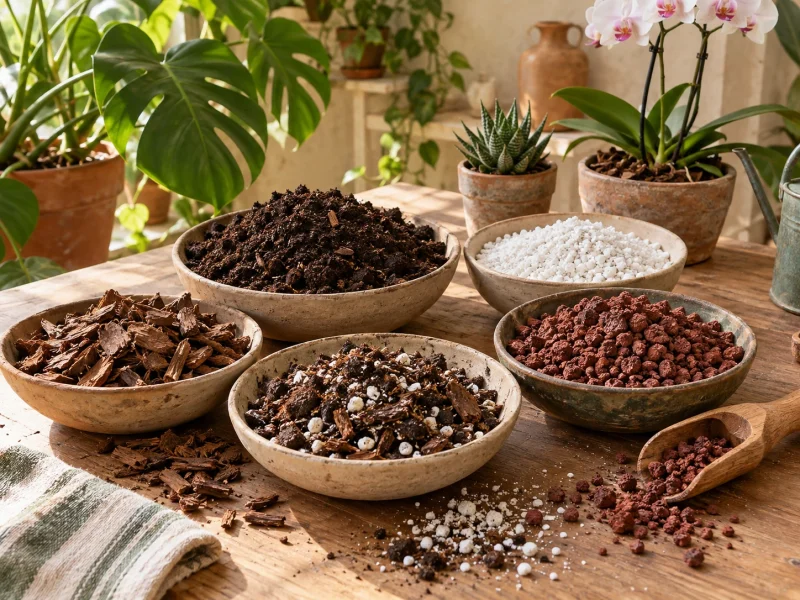
A good potting mix does three things: holds water, lets air through, and feeds and anchors the plant. For most tropical houseplants, start with roughly equal parts rich material (indoor potting soil, which you can blend with sieved mature compost), fibres (coco chips, bark) and draining material (perlite, pozzolana), then adjust to the plant, the pot and your watering. Avoid garden soil, fine sand and layers of pebbles at the bottom of the pot.
- Cacti and succulents: a very mineral mix, roughly 2/3 mineral to 1/3 rich material.
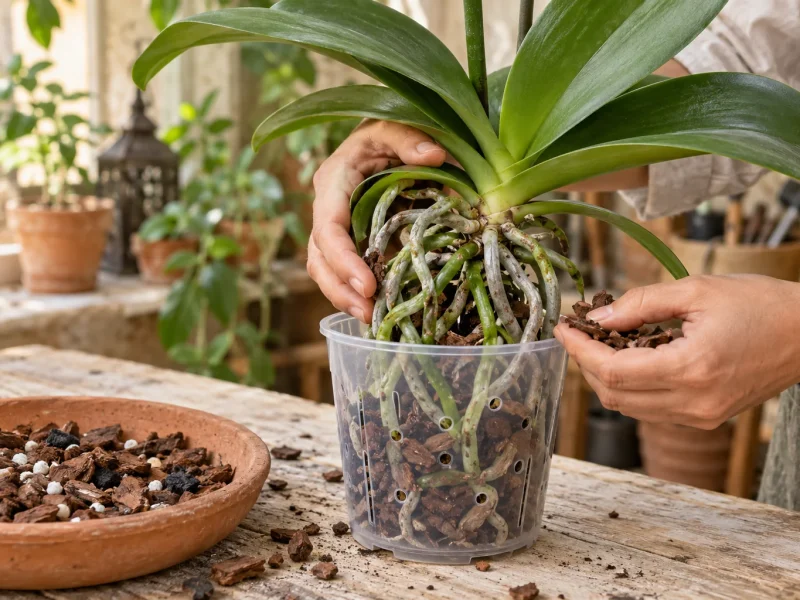
- Orchids: bark, no potting soil.
- Calathea, ferns: more water retention (vermiculite, coco), without stagnation.
- In Morocco: hard water crusts up potting mixes, and heat and air conditioning dry them out fast; an airy mix and regular flushing make the difference.
Contents
- What is a potting mix, and why not garden soil?
- The three functions of a potting mix
- The ingredients, one by one
- What about peat?
- What proportions?
- What Morocco changes
- Ready-to-use, kits or individual ingredients?
- How to judge a potting mix
- When to change the potting mix?
- Feeding the potting mix
- Specialist mixes
- The classic mistakes
- Frequently asked questions
- Going further: the guides in this series
What is a potting mix, and why not garden soil?
A growing medium is anything a plant grows in: the term is broader than “potting soil” and covers a ready-to-use blend just as much as a mix of individual ingredients. Potting soil is a blend ready for repotting. Garden soil is neither.
In a pot, garden soil causes three problems: it compacts, driving out air and suffocating the roots; it holds water unevenly; and it may contain seeds, fungi and pests. Garden soil works thanks to its volume, depth and biological life, which a pot can’t reproduce. A mix designed for containers is the better choice.
The three functions of a potting mix
| Function | What it means | What provides it |
|---|---|---|
| Holding water | Keeping moisture available to the roots between waterings | Coco fibre, compost, vermiculite, biochar |
| Letting air through | Keeping gaps where oxygen can circulate | Perlite, pozzolana, bark, coco chips |
| Feeding and anchoring | Supplying nutrients and holding the plant steady | Compost, potting soil, fertiliser; the mass and weight of the mix |
The whole art of potting mix is a balance between water and air. Too much water and not enough air: the roots rot. The reverse: the plant dries out. Each ingredient moves the slider one way, which is why it pays to combine them. The right balance depends on the plant: see which potting mix for which plant.
The ingredients, one by one
| Ingredient | Main role | Water | Air | Feeds? | Lifespan | From us |
|---|---|---|---|---|---|---|
| Indoor potting soil | Base of the mix | Medium to high | Medium | A little | 1 to 3 years | See all-purpose compost or Signature Potting Mix |
| Mature compost | Organic matter, microbial life | High | Medium | Yes | 1 to 2 years | See the compost article |
| Coco chips | Aerates while holding a little moisture | Moderate | Good | No | Long | 30 MAD per litre |
| Bark | Structure, aeration, aerial-rooted plants | Low | Excellent | No | Medium | 30 MAD per litre |
| Perlite | Lightens, aerates, drains | Low | Excellent | No | Very long | 20 MAD per litre |
| Vermiculite | Holds water and nutrients | High | Fair | No | Medium, compacts | 35 MAD per litre |
| Pozzolana | Lasting drainage, adds weight | Low | Excellent | No | Very long | 40 MAD per litre |
| Biochar | Holds water and nutrients, gives structure | Moderate | Good | After “charging” | Very long | Horticultural biochar, 60 MAD |
| Clay pebbles | Mulch, bed under the pot, aeration in a mix | Low | Good | No | Very long | 30 MAD per litre |
Indicative prices as of October 2026, for the 1-litre size (except biochar: see the product page). The 2- and 5-litre sizes work out cheaper per litre.
Indoor potting soil
It’s the base of most mixes. Its quality depends on its composition, which the label should spell out: see reading a potting soil label. On its own, shop-bought potting soil often compacts and holds a lot of water: it’s improved with fibres and draining materials.
Compost
Compost is plant matter broken down by micro-organisms. It provides organic matter, water retention and slow-release nutrients. For indoor use it must be mature and sieved: young compost gives off ammonia that burns roots and attracts gnats. It goes into a mix as an ingredient, usually between 10 and 30% of the volume when it complements a potting soil, rarely on its own. All the details are in our article on compost.
Coco chips
These pieces of coconut husk aerate the mix and hold some moisture without making it soggy. Soak the chips for a few minutes before use: they swell and lose some of their salts. They’re a renewable plant by-product that breaks down slowly.
Bark
It adds body and aeration. Essential for orchids and aerial-rooted plants (some Philodendrons, Anthuriums), it also improves mixes for climbing aroids.
Perlite
Expanded volcanic glass: white, light and porous. It aerates and drains but holds little water. It doesn’t feed. It rises to the surface when you water — that’s normal.
Vermiculite
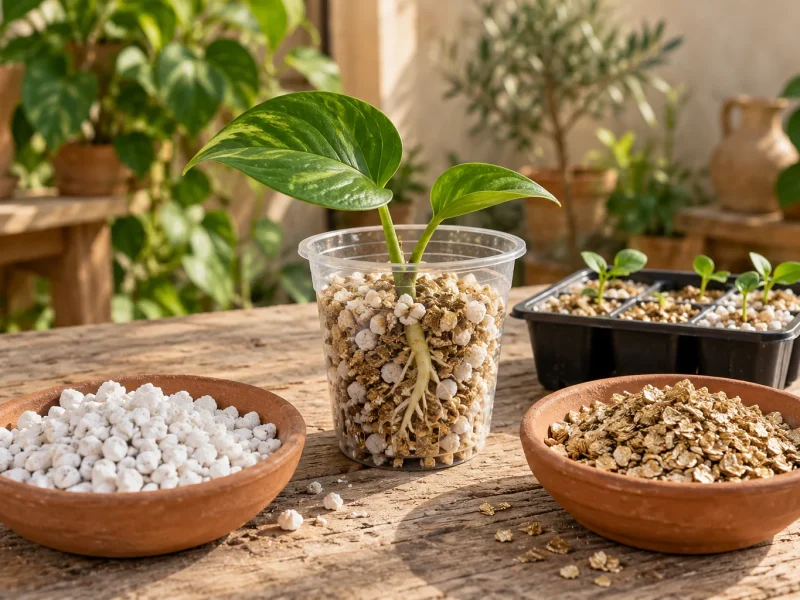
A mica-type mineral expanded by heat, which holds water and nutrients and releases them gradually. Ideal for seedlings, cuttings and plants that like to stay moist. In excess, it compacts.
Pozzolana
A porous, heavy, angular volcanic rock. It drains for the long term, doesn’t compact and weighs down large pots. It’s the go-to ingredient for cacti. Spread on the surface, it reduces evaporation.
Biochar
A porous plant-based charcoal. Its structure holds some water and nutrients and provides a home for microbial life. Our horticultural biochar is made in Morocco from olive-growing by-products. It is “charged” before use (mixed with mature compost, or soaked in diluted organic fertiliser). Its effects depend on the starting potting soil, the plant and the dose: see our article on biochar.
Clay pebbles
Useful as a mulch, as a bed under a pot inside a planter, or mixed in a small proportion. Not at the bottom of the pot: a layer of pebbles doesn’t drain — we explain why here.
The comparison of perlite, vermiculite, pozzolana and coco chips is detailed in their dedicated guide.
What about peat?
Peat is the base material of most shop-bought potting soils: light, highly absorbent, almost sterile and very acidic. But it’s extracted from peat bogs, habitats that store huge amounts of carbon. Draining them to harvest the peat releases that carbon. That’s why we champion compost, fibres and draining materials in its place for everyday repotting. The reasons, figures and alternatives are in our article on compost. To spot peat on a bag, see reading a potting soil label.
What proportions?
There’s no universal recipe, only starting points. For a tropical foliage houseplant (Monstera, Philodendron, Pothos), start with:
- one third rich material (indoor potting soil, which you can blend with sieved mature compost);
- one third fibres (coco chips, fine bark);
- one third draining material (perlite, pozzolana).
Then adjust: more draining material for plants that dislike wet feet; more fibres and rich material for those that like to stay moist. A small handful of charged biochar can round it all off.
| Plant | Adjustment |
|---|---|
| Monstera, Philodendron, Pothos | Basic mix, more bark for climbers |
| Calathea, Maranta, ferns | More rich material, vermiculite or coco |
| Alocasia, Anthurium | A light, rich, airy mix |
| Ficus, Dracaena | Two parts rich material, one part bark, one part perlite or pozzolana (stability for large pots) |
| Peperomia, Hoya, Zamioculcas | More perlite, less rich material |
| Cacti, succulents | Two thirds mineral (pozzolana and perlite), one third rich material |
| Orchids | Bark, a few coco chips, no potting soil |
The details, family by family, are in which potting mix for which plant.
What Morocco changes
Potting mix advice is often written for temperate climates and soft water. In Morocco, three factors shift the rules.
Hard water
Tap water is hard in many Moroccan cities. With every watering it deposits salts in the potting mix: a white crust on the surface, rising pH, scorched leaf tips on sensitive plants (Calathea, Maranta). An airy mix, an occasional flush — at the change of season, for example (water generously until it runs out of the holes, to wash out some of the salts) — and, where possible, rainwater or filtered water limit the problem. It’s all explained in tap water and your plants.
Heat and air conditioning
A hot summer and constant air conditioning dry potting mixes quickly. A breathable terracotta pot speeds up evaporation even more. Conversely, in winter, with reduced light and coastal humidity, a mix can stay damp for a long time: you then need an airier mix and less frequent watering. These rhythms are described in when to water, autumn and winter care and plants in an air-conditioned office.
Locally available materials
Some materials are produced in Morocco (olive-wood biochar, for example); others are imported. When choosing, check the origin and composition: see reading a potting soil label.
Ready-to-use, kits or individual ingredients?
| Option | Advantages | Limitations | Best for |
|---|---|---|---|
| Ready-to-use potting mix: Signature Potting Mix, cactus and succulent mix | Quick, consistent | Less adjustable | One or two pots |
| Home Potting Mix Kit (perlite, vermiculite, coco chips, pozzolana) | The four basic ingredients, at a reduced price | Contains no potting soil or compost | Several pots, custom mixes |
| Cactus and Succulent Kit | Cactus mix and pozzolana | For cacti and succulents only | Repotting plants that dislike wet feet |
| Individual ingredients | Precise proportions, 1, 2 and 5-litre sizes | Requires learning the proportions | Collectors, large quantities |
Prices are in the potting mixes category. For example, the Home Potting Mix Kit is 115 MAD and the Cactus and Succulent Kit is 90 MAD. A 16 cm pot needs about one litre of fresh potting mix, a 25 cm pot three to four litres: see the calculation in our repotting guide.
How to judge a potting mix
Three simple tests, no equipment needed:
- The handful test. Squeeze a handful of moist mix. It should hold a loose shape, then crumble at a touch. If it forms a paste, it’s too dense. If it doesn’t hold together at all, it’s too dry or too mineral.
- The watering test. Water should soak in within ten seconds or so and come out of the holes. If it sits on the surface for more than about fifteen seconds, the mix is probably compacted.
- The drying test. The mix should dry out within a few days to a week, depending on the plant, not over several weeks. Touch it rather than following a schedule: see when to water.
When to change the potting mix?
Usually every one to three years: the mix compacts, becomes depleted and holds water differently. Signs that it’s time to repot: water runs straight through or sits on top, a hard crust forms, the mix pulls away from the sides, roots come out of the holes. Between repottings, top-dressing (removing the top three to five centimetres and replacing them) gives it a little new life. The steps are in our repotting guide.
Feeding the potting mix
Fresh potting mix contains nutrients for a few weeks. After that, the plant needs topping up during the growing season, from spring to late summer. A few fertilisers from our shop:
- liquid compost tea, which feeds the roots and the life in the potting mix;
- frass fertiliser;
- seaweed foliar feed, as a spray;
- and, for foliage care, ready-to-use black soap for plants, which keeps it clean and protects it from pests.
The Plant Care Kit brings together our three care products: compost tea root feed, seaweed foliar feed and black soap for plants. Proper use and dosages are in our fertiliser guide. Fertiliser doesn’t make up for a lack of light or poor watering.
Specialist mixes
- Cacti and succulents: mineral and free-draining, see the dedicated guide.
- Orchids: bark, no potting soil.
- Seedlings and cuttings: vermiculite and perlite, a fine, light mix.
- Terrariums: a mix suited to a closed space, which we teach in our workshops.
- Kokedama: a ball of enriched potting mix and moss, watered by soaking.
- Indoor bonsai: a very free-draining, structured mix, with careful watering.
The classic mistakes
- Repotting in garden soil.
- Using fine or beach sand, which clogs or brings in salt.
- Putting pebbles or gravel at the bottom of the pot.
- Choosing a pot that’s too big and a mix that stays wet.
- Pressing the mix down hard.
- Using all-purpose compost for everything, including cacti and orchids.
- Using young compost in pots.
- Feeding straight away after repotting.
- Ignoring hard water, which crusts up the mix.
Frequently asked questions
What’s the best potting mix for houseplants?
There isn’t just one. For tropical foliage plants, a mix of equal parts rich material (potting soil, possibly blended with mature compost), fibres (coco, bark) and draining material (perlite, pozzolana). For cacti, a very mineral mix. For orchids, bark.
Is all-purpose compost enough?
It suits many plants, but it’s often dense and holds moisture. For tropical houseplants, it’s better improved with fibres and perlite. See all-purpose compost or Signature Potting Mix.
Can I make my own potting mix?
Yes, with a rich base and two or three ingredients. The Home Potting Mix Kit brings together the four basic ingredients.
Perlite or pozzolana?
Both drain. Perlite is light and aerates; pozzolana is heavy, long-lasting and steadies large pots. See our comparison.
How much potting mix should I buy?
About half the volume of the new pot: one litre for a 16 cm pot, three to four litres for a 25 cm pot.
Why has my potting mix gone hard?
It has compacted, or limescale from the water has formed a crust. Scratch the surface, flush thoroughly, and repot if the problem persists.
Is sand suitable for houseplants?
Not fine sand, which fills the pores of the mix. Choose perlite or pozzolana instead. Beach sand should never be used (salt).
Where can I find potting mixes and ingredients in Rabat?
In our online shop, with delivery (40 MAD) or collection from the studio at 6 Rue Zemmour, Aviation district, Rabat. Tell us your plant and your pot and we’ll recommend the right mix.
Going further: the guides in this series
- Repotting a houseplant: when, how, which pot and which potting mix
- Drainage: clay pebbles, pots without holes, saucers
- Which potting mix for which houseplant?
- Reading a potting soil label
- Perlite, vermiculite, pozzolana, coco chips
- Cactus and succulent potting mix
- Compost: why it should replace peat
- Biochar: what does it do in potting soil?
- Is tap water harming your plants?
- When should you water your plants?
Not sure about a mix? Tell us your plant and your pot on WhatsApp at 06 61 05 26 38. The studio is at 6 Rue Zemmour, Aviation district, Rabat, Monday to Saturday, 11am to 3pm; see also our workshops.